- TRIPOLI: NATO accused Libyan leader Muammar Qaddafi on Saturday of using mosques and children’s parks as shields for his military operations, saying the longtime ruler who lashed out against alliance airstrikes is the one “brutally attacking the Libyan people.” Hours later, at least two explosions shook Tripoli as NATO jets soared above the capital.
- It was not immediately clear what had been hit or if there were casualties in the late afternoon raid.
In a telephone call piped through loudspeakers to a few thousand people demonstrating in Tripoli’s Green Square on Friday, Qaddafi railed against NATO following a day of intensified bombing runs in the capital. NATO’s mandate is to protect civilians amid a four-month uprising that has devolved into a civil war.
“NATO will be defeated,” Qaddafi yelled in a hoarse, agitated voice to the crowd. “They will pull out in defeat.” In Brussels on Saturday, NATO spokeswoman Oana Lungescu dismissed Qaddafi’s speech as “outrageous.”
“We are saving countless lives every day across the country,” she said. “We are conducting operations with utmost care and precision to avoid civilian casualties. Civilian casualties figures mentioned by the Libyan regime are pure propaganda.”
She also accused Qaddafi and his regime of “systematically and brutally attacking the Libyan people,” saying government forces “have been shelling cities, mining ports and using mosques and children’s parks as shields.” NATO has been ramping up the pressure on Qaddafi’s more than four-decade-old regime. Though most airstrikes happen under cover of darkness, daytime raids have grown more frequent.
Lungescu’s comments also counter allegations from Libyan Prime Minister Al-Baghdadi Al-Mahmoudi, who accused NATO on Friday of a “new level of aggression” and said the military alliance has intentionally targeted civilian buildings in recent days, including a hotel and a university.
“It has become clear to us that NATO has moved on to deliberately hitting civilian buildings. ... This is a crime against humanity,” he told reporters in the capital.
Defense officials in London on Saturday gave details of British air strikes over the previous two days, indicating an upswing in fighting along the Tunisian border in the far west.
Maj. Gen. Nick Pope, chief of the Defense Staff’s Communications Office, said British fighter jets destroyed three armed Libyan trucks and badly damaged a fourth in the mountainous region around the rebel-held city of Nalut.
Abdel Salam Othman Abou el-Qassam, speaking by phone from the operations room of rebel Western Mountain military council, said Qaddafi forces tried to advance Friday on Nalut. They cut electricity and water supplies, after pounding the city with mortar fire for several days.
The rebels blocked the advance, he said, in heavy fighting with hundreds of pro-Qaddafi fighters. Eight rebel fighters died.
A day earlier, Pope said, jets used Paveway guided bombs to destroy a convoy of four armed trucks 60 miles south of Misrata. Rebels have been fighting for weeks to break out of the port city toward Tripoli, 125 miles (200 kilometers) to the west.
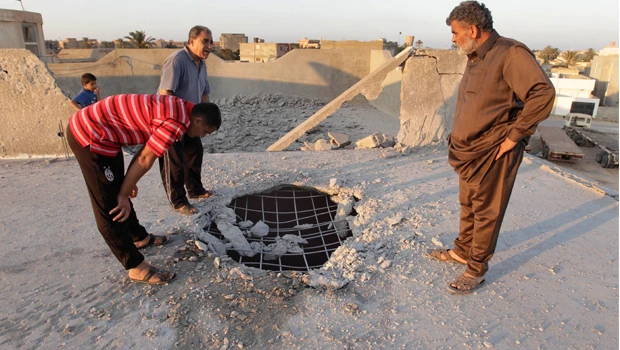
Officials on Saturday took journalists to visit a university building that the government claims was hit by a NATO airstrike.
Students and faculty told reporters that an explosion that tore a hole in a three-story building housing classrooms and offices happened sometime midday Friday, though accounts differed on the timing.
One English-speaking student interviewed by The Associated Press was being told what to say in Arabic by a plainclothes government official standing nearby.
No one was reported injured or killed. The campus sits a few hundred yards (meters) from what appears to be a military installation. The building that was damaged was an aging concrete structure next to what students said were new university buildings under construction.
Libya’s Health Ministry released new casualty figures that put the number of civilians killed in NATO airstrikes through June 7 at 856. There was no way to independently verify the figure and previous government-announced tolls from individual strikes have proven to be exaggerated.
A coalition including France, Britain and the United States launched the first strikes against Qaddafi’s forces under a United Nations resolution to protect civilians on March 19. NATO, which is joined by a number of Arab allies, assumed control of the air campaign over Libya on March 31.
In Rome, Italian Defense Minister Ignazio La Russa said any Italian debate about the possibility of ending active involvement in the NATO campaign in Libya could encourage its allies to push for a non-military resolution.
“I say that the government and parliament thinking about a date for the closure of our active participation could serve as a stimulus to our British, French and American allies to find a diplomatic way out of the crisis,” La Russa said in an interview published Saturday by the daily Corriere della Sera.
La Russa said Italy could “consider the hypothesis of setting a term to our active participation in the mission” although “the willingness to make our bases available would remain.”
He said any decision on a change of policy would not come before the end of the current 90-day period authorized for the mission at the start of June.
“In that period, as a country which is involved in the actions of which thus has a voice which counts, we should work as best we can to favor diplomatic and political solutions which could lead to the period after Qaddafi,” he said.
La Russa’s comments appeared in part aimed at conciliating Prime Minister Silvio Berlusconi’s coalition allies in the pro-devolution, anti-immigrant Northern League party, who have been against the mission from the start.
But they also underline growing unease in the western alliance at the lack of progress in toppling Libyan leader Muammar Qaddafi, who has vowed to resist to the end.
Italy, previously Qaddafi’s closest friend in Europe, has recognized the rebel Transitional National Council and on Friday signed an accord aimed at limiting a flood of illegal immigration from Libya with council leader Mahmoud Jebril.
It has made air bases available to the NATO-led alliance, provided logistical support and assigned eight combat aircraft to the operation but the struggling center-right government is divided over its involvement.
Coalition divisions have resurfaced after two crushing defeats in local elections and referendums in recent weeks and the Northern League is expected to voice their concerns at a party rally on Sunday.
The League’s support is vital to the survival of the government and the rally will be closely watched for signs that it may be considering pulling out of the coalition, a move which would trigger early elections.
La Russa said the government would be looking at cutting the cost of all of Italy’s foreign military missions, which include more than 3,800 troops in the NATO force in Afghanistan.
“I think it is possible to make a series of choices which would allow us not to fail the international commitments of a country like Italy but which at the same time, would allow us to make significant savings in the cost of the missions,” he said.