- JEDDAH: The Organization of the Islamic Conference said Wednesday it has sent a delegation to Libya to pave the way for mediation by the group to resolve the crisis in the North African state.
Secretary-General Ekmeleddin Ihsanoglu "dispatched a high-level political delegation to Libya to get to know the reality on the ground and developments taking place," a statement by the organization said.
The mission, led by the head of the OIC's political department, Mahdi Fathalla, will hold "consultations with the concerned parties in Libya and discuss some ideas on the Libyan issue which the OIC secretary-general had already discussed with the Europeans during his recent European tour," it said.
The delegation will meet officials in Tripoli and members of the National Transitional Council in Benghazi.
The announcement comes ahead of June 28-30 meeting of OIC foreign ministers in Astana, Kazakhstan.
Meanwhile, possible cracks emerged in the NATO air campaign as Italy expressed concern about the accidental killing of civilians and called for a suspension in hostilities to allow the delivery of humanitarian aid. However, Britain insisted the alliance was "holding strong."
Skepticism over the military campaign has been growing as weeks of airstrikes have failed to unseat Libyan leader Muammar Qaddafi and outrage rose over allegations that airstrikes have caused civilian casualties in Tripoli.
The air campaign continued Wednesday. At least two explosions shook Tripoli before noon as fighter jets soared overhead. It was not immediately clear what had been hit or if there were casualties.
In Rome, the Italian foreign minister called for a suspension in fighting so aid corridors could be set up. "The humanitarian end of military operations is essential to allow for immediate aid," including in areas around Tripoli and the rebel stronghold of Misrata, Foreign Minister Franco Frattini said.
Frattini also expressed concern over civilian casualties, referring to "dramatic errors" in the bombing campaign. "With regard to NATO, it is opportune to ask for more detailed information on results" in the attacks, he said in comments to a parliamentary commission.
In London, Britain's David Cameron insisted that the NATO-led alliance was "holding strong," and would complete its task in Libya. His office said Britain would not support Frattini's call for a halt to the air campaign to allow access for humanitarian aid.
"We are very clear that the right approach at the current time is to increase the pressure on Qaddafi's regime," Cameron's spokesman Steve Field told reporters. He said there was no evidence that aid was not reaching civilians.
NATO acknowledged it may have struck a residential building and caused civilian casualties in Tripoli earlier this week. It also hammered a compound belonging to a close Qaddafi associate, Khoweildi Al-Hamidi, and killed what Libya says was at least 15 civilians, including at least three children. NATO said that target was a "command and control" center.
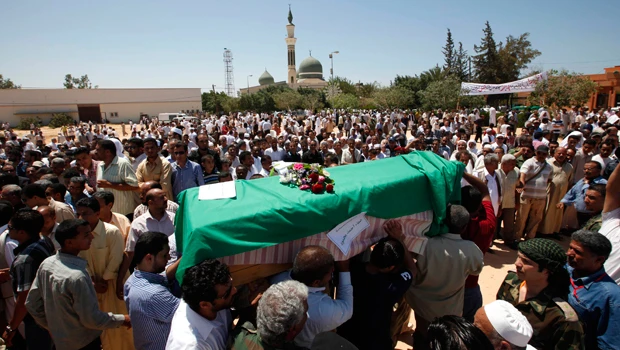
Hundreds of mourners gathered near the compound outside the town of Surman, 60 km west of Tripoli, on Wednesday to bury those killed in the strike.