- RAMALLAH / JERUSALEM: Israel’s prime minister said Thursday that the government will withhold privileges from Palestinian prisoners because Hamas has rejected a Red Cross appeal to visit a long-held Israeli soldier.
Benjamin Netanyahu did not offer many details. He told a conference, “I stopped that absurd procedure whereby terrorists in Israeli prisons who murdered innocent people register for academic studies. ... There won’t be M.A. students for murder or doctoral candidates for terror,” according to The Associated Press. Earlier Thursday, the International Committee of the Red Cross (ICRC) asked to visit Sgt. Gilad Shalit, who has been held captive by Palestinian resistance fighters linked to Hamas for five years.
Meanwhile, the Hamas movement on Thursday rejected the demand to provide proof that kidnapped Israel soldier Gilad Shalit is still alive.
Ismail Radwan, a Gaza-based Hamas spokesman, said that his movement “refuses to respond to this call.”
On early Thursday, ICRC said in a public appeal that Shalit’s family had a right under international humanitarian law to be in contact with their son. Shalit is still held in Hamas captivity since 2006. In October 2009, Hamas released a short video for Shalit in exchange for the release of 20 Palestinian women.
“Because there has been no sign of life from Mr. Shalit for almost two years, the ICRC is now demanding that Hamas prove that he is alive,” the Geneva-based organization said.
Radwan said that the “ICRC should have talked about the suffering of 7,000 Palestinian prisoners inside Israel.”
He added that the Israeli government of Prime Minister Benjamin Netanyahu blocks Shalit’s release by ignoring Hamas’ demands.
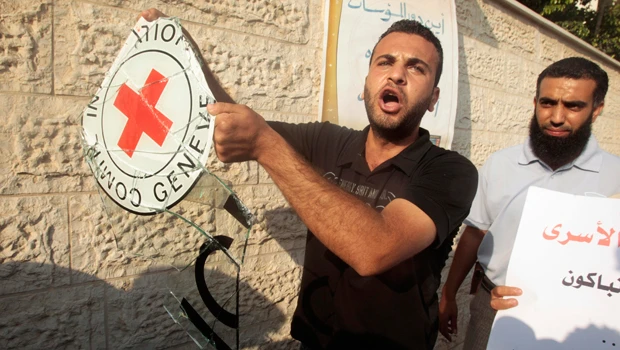
Palestinians threw eggs at the ICRC office in Gaza on Thursday to protest its demand.
Dozens of angry protesters also chanted slogans against the ICRC and ripped down and destroyed the Red Cross sign over the office.
Since December 2009, Egypt, Germany and France had failed to finalize the prisoners’ swap deal for the release of Shalit in exchange for hundreds of Palestinian prisoners. The failure is due to differences between Hamas and Israel.
Hamas wants Israel to free up to 1,000 Palestinians in Israeli prisons in exchange for the release of Shalit, and the Palestinian movement has reportedly presented a list of 450 names in Israeli prisons.
Israel also objects to freeing Israeli Arab prisoners as well as several Hamas military wing leaders. Another issue yet to be settled is Israel’s demand to deport almost 100 of the 450 “heavy” prisoners set to be released in the deal.