
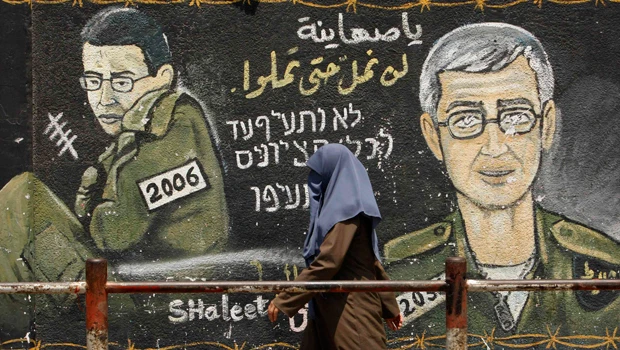
- GENEVA: The International Red Cross called on Hamas on Thursday to provide proof that Israeli soldier Gilad Shalit is still alive five years after his capture by Palestinian militants.
In an unusual public appeal, the independent aid agency said Shalit’s family had a right under international humanitarian law to be in contact with their 24-year-old son, held incommunicado since his capture on June 25, 2006.
“Because there has been no sign of life from Mr. Shalit for almost two years, the ICRC is now demanding that Hamas prove that he is alive,” the Geneva-based International Committee of the Red Cross (ICRC) said.
The ICRC also reiterated its long-standing request to visit Shalit in custody.
But a Hamas spokesman appeared to dismiss the appeal — which senior ICRC officials said had been transmitted privately to the militant Islamist group several weeks ago.
“The Red Cross should not get involved in Israeli security games aimed at reaching Shalit. It should take a stand that results in ending the suffering of Palestinian prisoners,” Hamas spokesman Sami Abu Zuhri told Reuters in Gaza.
Hamas-led gunmen tunnelled from Gaza into Israel to seize Shalit, who has been held at an unknown location in Gaza ever since. The last sign of life was a videotape released by his captors in September 2009 showing Shalit, pale and thin, pleading for his life.
“The total absence of information concerning Mr. Shalit is completely unacceptable,” ICRC Director-General Yves Daccord said in a statement.
In a bid to put ressure on Hamas, Israeli Prime Minister Benjamin Netanyahu said Palestinian militants held in Israeli jails would face tougher conditions.
“I have stopped a procedure by which terrorists in Israeli jails enroll in academic studies. There will be no more students of murder, no more doctoral students in terror,” Netanyahu said at a conference in Jerusalem.
Shalit, who also holds French nationality, has become a symbol for Israelis, many of whom do compulsory military service and identify with his plight.
“We don’t know anything about his conditions of detention. But from information available to us we have serious concerns about his fate,” Jean-Pierre Schaerer, head of the ICRC delegation in Israel and the occupied territories, told Reuters.
The ICRC is ready to facilitate an exchange of prisoners if Israel and Hamas come to an agreement, Schaerer said. About 5,500 Palestinians are in Israeli jails, including those convicted and those yet to face trial.
But he added: “There is no reciprocity between the situation of Gilad Shalit and people detained by Israel. Both sides have obligations, independent of what the other side is doing.”
Shalit is not considered a prisoner of war, as he was seized by an armed group rather than by forces of a state that has ratified the Third Geneva Convention. However, like all other detainees captured in conflict, he is entitled to humane treatment under the Geneva Conventions, according to the ICRC.
Shalit’s parents Noam and Aviva have said they will spend Saturday, the fifth anniversary of his capture, in a tent plastered with signs urging Israeli leaders to bring their son home.
They have led a campaign to press Netanyahu to agree to a prisoner swap with Hamas.
Netanyahu’s rightist government balks at meeting Hamas’ demands to free hundreds of prisoners, calling it too great a security risk.
In a separate statement, the ICRC urged Israel to allow relatives of Palestinian detainees from Gaza to visit them in custody in Israel.
The Jewish state suspended visits in June 2007 in a move which the ICRC said contravened international humanitarian law and had prevented more than 700 families from seeing their detained relatives over the past four years.