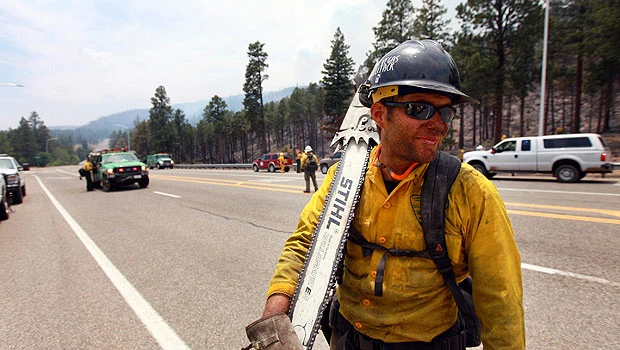
- LOS ALAMOS, New Mexico: The threat of wildfire reaching the Los Alamos nuclear lab and the town that surrounds it eased as crews made progress under cloud cover and rain Friday.
The fire has blackened more than 420 square km in the last six days, making it the largest fire in New Mexico history. Firefighters were confident their crews would be able to keep flames from spreading down a canyon that leads to the lab and the town.
“The way it looks is we made good progress on that side as far as holding the fire from going any farther toward Los Alamos along the canyon,” said fire information officer Rick Barton. “The guys are burning out in that area in places trying to strengthen the lines that we have established.”
Los Alamos Canyon runs past runs past the old Manhattan Project site in town and a 1940s-era dumpsite where workers are near the end of a cleanup project of low-level radioactive waste. Workers from the era dumped hazardous and radioactive waste in trenches along 6 acres atop the mesa where the town sits.
“The threat is pretty limited,” said Kevin Smith, the Department of Energy’s National Nuclear Security Administration site manager for Los Alamos, which over sees the lab. Los Alamos Canyon also runs through town and a portion of the northern end of the lab, where a weapons research nuclear reactor was located until it was demolished in 2003.
The fire burned upslope at least 5 five km from the sites and didn’t pose an immediate threat. Fire had crept to within a kilometer of homes in town.
Lab officials were trying to determine the extent to which thousands of experiments at the facility have been affected by a shutdown caused by the fast-moving fire. Lab Director Charles McMillan said teams would quickly figure out how things stand as soon as they’re able to return.
The lab has been closed since Monday, when the town of Los Alamos and some of its surrounding areas — 12,000 people in all — were evacuated. There was no word on when it would reopen. Tucker said Los Alamos residents won’t be allowed back home until Sunday at the earliest.
Officials said the lab has some 10,000 experiments running at the same time that have been put on hold.
The delayed projects include studies on materials needed to extend the life of 1960s-era B61 nuclear bombs as well as experiments run on two supercomputers. The lab works on such topics as renewable energy and particle physics, solar flares, forensics on terrorist attacks, and studying the AIDS virus at the molecular level to help scientists develop strategies for developing vaccines.
On Monday, about an acre of lab property burned, raising concerns about possible contamination Lab authorities, along with outside experts on nuclear engineering, expressed confidence that the blaze would not scatter radioactive material, as some in surrounding communities feared.
Anti-nuclear groups sounded the alarm about thousands of 55-gallon drums containing low-grade nuclear waste — gloves, tools, even paper notes and other contaminated items — about three km from the fire.
Lab officials said it was highly unlikely the blaze would reach the drums, and that the steel containers can in any case withstand flames and will be sprayed with fire-resistant foam if necessary.
Meanwhile, lands held sacred by a Native American tribe were being hit by the fire. Santa Clara Pueblo Gov. Walter Dasheno said his people are devastated by the news coming in from the front lines of the firefighting efforts — cultural sites destroyed, forest resources lost and plants and animals that the pueblo’s 2,800 residents depend on gone.