
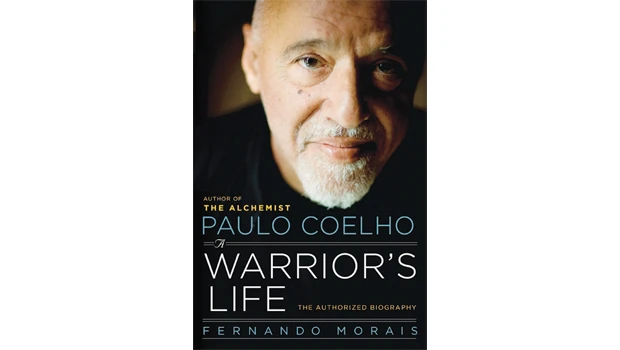
- A Warrior’s Life by Fernando Morais gives us a chance to understand the personality of the man, “an alchemist of words,” who has touched the heart of millions of readers all over the world.
Brazilian born, Paulo Coelho took the literary world by storm with “The Alchemist” (1988) — one of the greatest best-sellers of all times, which was written in two weeks. With more than 100 million books sold and published in 159 countries, Coelho is now one the most widely read authors in the world.
Success, however, did not come easily, as he had to wait until he was 40 to savor his first literary accomplishment with “The Pilgrimage” (1987). And, even then, critics were not kind: “Merciless and on many occasions almost rude, the main newspapers in Rio and Sao Paulo seemed determined to demolish him,” writes Morais who has enjoyed unprecedented access to the diaries Coelho has been writing since his adolescence.
Although he was feted at the Frankfurt Book Fair in 1994 when Brazil was the guest of honor, Diego Mainardi wrote in the magazine Veja that Coelho is not a legitimate representative of Brazilian literature and that “he shouldn’t present himself as a writer. When all’s said and done, there’s as much literature in Paulo Coelho as there is in my dirty socks.”
Jorge Amado, a well-known Brazilian writer who was not part of the delegation, rallied to Coelho’s defense: “The only thing that makes Brazilian intellectuals attack Paulo Coelho is his success,” he said.
And, indeed, a year later in 1995, the British press spoke of a “Coelhomania” that culminated in France where two famous critics, Frederic Vitoux and Eric Deschot, compared “The Alchemist” to the iconic “Le Petit Prince” by Antoine de Saint-Exupery.
The release of “Veronika Decides to Die” in 1998, marked a turning point in his relationship with the press. The shocking revelations of Coelho’s three internments in an asylum, and the suffering he incurred, certainly affected the way the journalists felt about him.
From a very early age, Coelho has been preparing himself to become a writer, and unsurprisingly, many of his books are inspired by events, dramatic and spiritual, that happened to him. When he wrote his first blockbuster, “The Alchemist,” he was finally ready. He had, so to speak, already written the story in his mind and therefore was able to finish 200 pages in merely two weeks. Morais explains that “Brida” (1990) was written “using a method he would continue to use from then on: he would ponder the subject for some time and then, when the story was ready, write the book in two weeks.”
From the age of 13 or 14, Coelho became obsessed with the idea of becoming a writer. In one of his recent novels, “The Zahir” (2005), he says:
“I write because when I was an adolescent, I was useless at football, I didn’t have a car or much of an allowance, and I was pretty much of a weed…And, I didn’t wear trendy clothes either. That’s all the girls in my class were interested in, and they just ignored me…I spent my free time creating a world in which I could be happy: my companions were writers and their books.”
When he won a poetry competition, both his parents discouraged him strongly to embrace a writing career, which he refers to in his diary as “his only reason for living.”
At the age of 16, in a conciliatory gesture, his father offered him a trip to Belem, but Coelho refused, telling his father, he would prefer a typewriter. His father gave him a Corona Smith, which he kept until he received an electric Olivetti, replaced now by a laptop. However, he waited another 26 years, when he turned 40, before he savored his first literary success.
During those years, always superseded by his fascination for anything spiritual, he battled with drugs and even developed a short, but dangerous, interest in black magic.
For a while, he gained certain fame and made good money as a lyricist and artistic director. But, his financial stability never made him forget his old dream of becoming a great writer. When he pondered on the fact that Agatha Christie made a fortune of $18 million from her book sales, Coelho wrote in his diary:
“There’s no way I want to publish my novels in Brazil. There’s no market for them here. In Brazil, a book that sells 3,000 copies is deemed a success, while in the United States that would be considered a complete flop. There’s no future here. If I want to be a writer, I’m going to have to get out of here.”
Coelho might have a spiritual nature, but he is extremely down to earth when money is concerned, and he is quasi obsessed with the sales of his books. Every time he publishes a new book, he is anxious to know if it is on the best-seller list. When he wrote his first book, “The Pilgrimage,” he distributed leaflets outside Rio’s cinemas and theaters and then asked the bookshops how many copies they had sold.
The high sales of his books worldwide are due to a strong desire to publicize his books. Coelho is always ready to be interviewed by journalists for newspapers and magazines and appear on radio and TV programs. He not only turned books into a popular consumer product, but also transformed spirituality into an interesting topic and definitely revolutionized the publishing market in Brazil.
Coelho lives part of the year near Tarbes in the south of France, in a disused mill, which he has converted in a house. His property portfolio also includes an apartment in Paris, another in Copacabana as well as a fully furnished mansion in Dubai, given to him by Sheikh Mohammed bin Rashid Al-Maktoum. Despite his wealth, he lives a simple life. When he spends time at his home at the foot of the Pyrenees, he is responsible for all the everyday tasks, such as sawing the wood for the fire, cutting the grass and sweeping the dead leaves. He does not have a chauffeur and does his own shopping.
When he travels, he takes modest luggage, which always consist of four black T-shirts, four pairs of colored silk boxer shorts, five pairs of socks, a pair of black Levi’s, a pair of denim Bermudas and a pack of cigarettes. For formal occasions, he adds a shirt with a collar, a tie and what he calls “his society shoes” and a pair of cowboy boots — all in black. The choice of color has nothing to do with mysticism, but as Morais explains:
“As someone who often spends two-thirds of the year away from home, he has learned that black clothes are more resistant to the effects of hotel laundries. Although, on most occasions, he washes his own socks, shirts and underpants.”
This biography has benefited from Coelho’s full cooperation. In fact, Coelho himself admits that he has told things to Morais that he had never told anyone — not even to himself. The book ends with a letter that Coelho addressed to Morais. Wondering whether he would recognize himself in this biography, he concludes that he shall be the characters who crossed his path:
“I exist because I have friends. I have survived because they were there on my path. They taught me to give the best of myself, even when at some stages in my life, I was not a good pupil. But, I think that I have learned something about generosity.”