
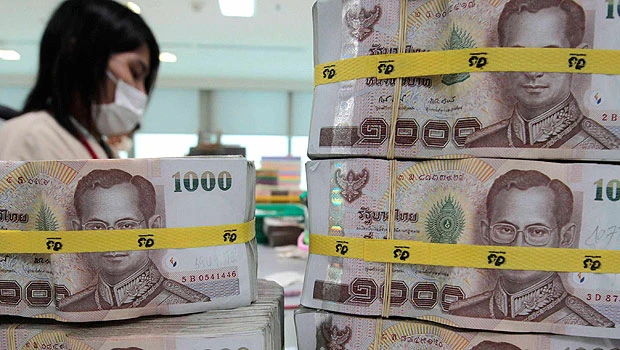
- BANGKOK: Thailand’s policy of allowing the baht to float freely will be maintained under its new government, Prime Minister elect Yingluck Shinawatra said.
The Bank of Thailand broadly lets market forces determine the level of the baht, intervening only to prevent too much volatility.
Yingluck said the idea of a more controlled currency was not her party’s policy, but Suchart Thada-Thamrongvech, a candidate for finance minister in the government led by Yingluck’s Puea Thai Party, said this week Thailand should “steer and manage” the baht to keep the currency at “a competitive level.”
He suggested that a flexible basket of currencies could be used to calculate the rate.
Yingluck said: “It’s not our policy. It’s just an initial analysis ... We are not intervening (in the baht). We will let it work under the current mechanism.”
She told the Wall Street Journal in an interview that the authorities would continue to let the baht appreciate against the dollar to limit imported inflation, and offset the inflationary impact of some of her party’s policies.
Puea Thai, the party backed by self-exiled former Prime Minister Thaksin Shinawatra, won Sunday’s election by a landslide, taking 265 of the 500 lower house seats.
Yingluck’s economic policies are widely expected to deliver a burst of consumer spending and investment, but economists say they could also cause problems from higher debt to an inflationary rise in the cost of business in Southeast Asia’s second-largest economy.
This week, she has been meeting with her economic team to fine-tune the policies and programs promised during the campaign, including a rise in the minimum wage of as much as 90 percent, depending on the region, to 300 baht ($9.70) a day.
For the past decade, Thailand’s minimum wage has trailed inflation, creating one of the widest gaps between rich and poor in Asia and fueling working-class frustration that spilled over into violent street protests last year.
Puea Thai has said it would change that by improving conditions for farmers, low-wage workers and young university graduates, in part by providing easy credit and lifting wages.
To compensate employers for the rise in wage costs, it has promised to cut the corporate tax rate to 23 percent next year and 20 percent a year later from the current 30 percent.
Yingluck says about 70 percent of employers already pay workers 300 baht or more a day. Critics say employers in remote rural areas with poor infrastructure will be hard-pressed to pay the same wages as those in or near Bangkok.
In theory, billions of extra dollars pumped into Thailand’s rural economy will stimulate consumption.
Under Thaksin, money funnelled into villages through a debt moratorium for farmers and cheap loans had a knock-on effect on the whole economy, fueling a boom in household spending in a type of policy known in Thailand as “Thaksinomics.”
Gross domestic product (GDP) grew on average by 5.7 percent a year between 2002 and 2006, despite high oil prices and an outbreak of the SARS virus. That compared with growth of 2.2 percent in 2001 and the economic turmoil of the late 1990s.
Yingluck has vowed to revive Thaksinomics, raising concern among economists and business leaders about a dramatic increase in debt and an acceleration in inflation.
Thailand’s debt-to-GDP ratio was already expected to rise from a current 42 percent to more than 60 percent — generally regarded as the safe limit for developed economies — within six years, according to the central bank. Sudden expansionary policies could accelerate that trend.
Inflation is also rising, reaching 4.2 percent in May, its highest in 32 months. A Reuters poll on Tuesday showed economists had revised up their expectations for interest rates following Yingluck’s election victory and expect the central bank to tighten faster than previously thought.
The benchmark rate may rise to 3.75 percent by year-end, up from a forecast of 3.50 percent before the election.