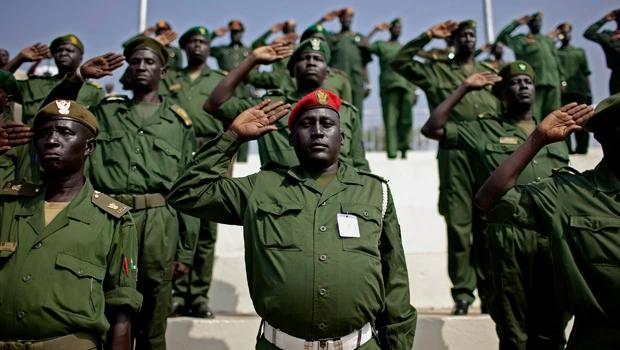
- JUBA, Sudan: South Sudan's legislative assembly has ratified the country's new constitution, the information minister said Thursday, denying that it put too much power in the president's hands.
"The new constitution is out," Barnaba Marial Benjamin said. He insisted that the people of the country had been widely consulted on the constitution and rejected suggestions that it concentrated too much power in the hands of the president.
"That is the choice of the people of south Sudan. They have discussed it democratically in Parliament and they have agreed to it, so that is the constitution," he said.
There has been some controversy in the run-up to the fledgling nation's full independence on Saturday, about the draft transitional constitution with many complaining that nongovernment figures had been excluded from the consultation process.
Civil society groups have warned that it could tighten the grip on power of the Sudan People's Liberation Movement (SPLM), the ruling party of the south.
On Saturday, the Carter Center, a monitoring group set up by former US President Jimmy Carter, repeated that warning. "The current draft of the transitional constitution contains a number of provisions that appear likely to concentrate power in the central government," a statement said.
South Sudan's President Salva Kiir is expected to sign the constitution during Saturday's independence ceremony.
A draft version of the constitution caused separate controversy in April for stating that the contested border region of Abyei was a part of the south's territory.
Sudan's President Omar Bashir said afterward that Khartoum would refuse to recognize the new state if it insisted on claiming Abyei. Benjamin denied Thursday that the disputed region would be unilaterally claimed by the south.
Bashir said Thursday he planned to attend the independence ceremony.
The president said: "After two days I will go to Juba to congratulate our brothers on their new state, and we will renew our commitment to help them because we want a southern state that is stable and secure."
"Because if it is not secure, the people of the south will come back to the north," he told thousands of supporters in a speech broadcast live on state television.
Around 360,000 southerners have already left the north and gone south since October, according to the UN refugee agency (UNHCR), many of them motivated by the simple desire to participate in the historic birth of their nation.
"We want relations based on an exchange of benefits and trade, and the free movement of citizens across the borders," Bashir added.
Bashir, however, warned the north would hold no more foreign talks on solving internal conflicts such as violence in the northern border state of South Kordofan where the army is fighting armed groups allied to the south.
Leaders of north and south agreed Monday in Ethiopia to continue talks on a series of issues both sides need yet to solve such as ending tensions in South Kordofan.
"After the betrayal in South Kordofan they come and want to hold talks ... But we will not hold any talks in Addis Ababa or elsewhere with those who take up arms," he said.