
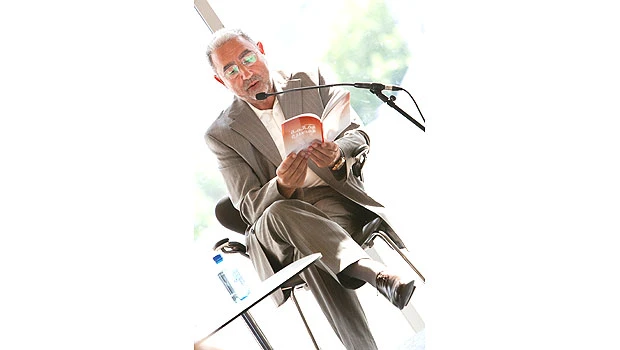
- Merging on one event, the Southbank Center’s 5th London Literature Festival and Shubbak, London’s festival of Arab contemporary culture, shared an afternoon: A reading by this year’s two winners of the International Prize for Arabic Fiction (IPAF).
Moroccan Mohammed Achaari's "The Arch and the Butterfly", and Saudi Arabian Raja Alem’s "The Dove's Necklace", had a common theme in their winning novels: They were both inspired by The Dove’s Necklace by medieval philosopher Ibn Hazem.
Lead by the animated author and literature expert, Paul Blezard, it was an afternoon that did well at cracking through to what contemporary Arabic literature deals with. Blezard spoke to the authors, engaged with the audience, and gave strong backgrounds on the literary tradition of the Arab world. The audience was mostly British Arabic-speaking bibliophiles; the crowd was intimate and knowledgeable. The authors spoke about censorship, poetry and, of course, their feelings about winning the esteemed prize.
Blezard started the discussion by quoting one of the judges of the IPAF, Iraqi writer Fathel Al-Azzawy, saying: “Good literature expels evil spirits, gives us wings to fly, makes us free men and women.”
It is from there that the magic of the words that brought us into the room took off.
The role of the novel is one that has only recently begun to take its place in Arabic literature. As a tradition that was mainly lead by prose, the novel has added a new dimension to ways of writing and reading. To this, Raja Alem added that literature doesn’t only give us wings, but insight: “Literature is a way of getting to know the human beings we are surrounded by.”
Alem’s writing has often referred back to her home city of Makkah, and her new novel is a poetic homage to the particular mountain on which her family home stood. Through her stories she aims to offer a glimpse at this place, exporting an idea that may otherwise be unreachable. For this, she feels that she holds a responsibility both to her subject as well as to her readers, allowing them to “reach inside each other” honestly.
Mohammed Achaari, on the other hand, comes from a background of poetry. He has worn many hats in the advancement of literature, education and culture, not only as a writer but also as a previous minister of culture of Morocco. In regards to the growing role of the novel in Arabic literature he advocates it as a more modern way of engaging intellectually.
“Readers want new challenges,” he said. “Novels are a way forward for Arab readers who have become accustomed to poetry.”
On writing the novel, he added that his interest has also advanced with his shift to novel writing. He is developing a new aesthetic and hopes to be able to portray realities and challenging situations and not only heritage and history.
Achaari’s winning novel does just that. A book that has received great praise for its honesty, the story is about a politically liberal father who receives word that his son was secretly fighting with the Taliban and was killed. Moving past orthodoxy and stating that he never limited himself to censorship, his characters are visceral and real, dealing with the tragedy and violence encountered in the Arab world. He explains that he does not hold back from writing about issues such as love, sex, corruption and social ills. On the contrary, these are the issues that we must address and readers must also face.
Clearly, there are many benefits to winning the IPAF. This includes talks and tours, a cash prize of $50,000 (to be shared between the two winners), and a guaranteed translation into English. But when asked what winning the prize means to either of them, they both had very different answers reflecting on the very different paths that got them there.
Alem expressed her gratitude as the first woman to win this prize. Being from Saudi Arabia, where women do not get the same exposure as men in the public eye, this was a leap that made her believe in herself, her work and all the women of Saudi Arabia and the rest of the Arab region.
Achaari responded to the prize differently, thinking that the distance at which Arabic literature has reached is signified through London’s interest in the prize. Unfortunately, the Arab world does suffer from limited readership so it is refreshing to know that there are more readers of Arabic literature around the world. Both agreed, however, that it was the ability to go on and have discussions with groups of interested people that make the prize so worthwhile.