
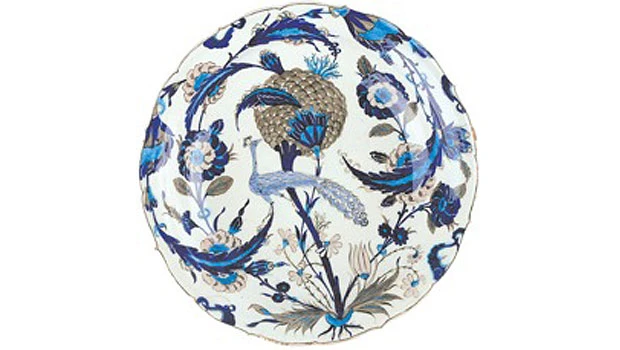
- The Louvre in Paris, the world’s most visited museum, does not have the largest collection of Islamic art — the honor goes to the recently reopened Museum of Islamic Art in Cairo — but it is one of the finest.
The collection, effectively formed in the latter half of the 19th and the early 20th centuries thanks to the efforts of historians and enthusiastic amateurs, has its roots in the few Islamic artifacts in the French royal collection. Following the revolution of 1789, these were handed over to the Central Arts Museum, the name given at the time to the Louvre. But it took another century before a specific Islamic arts section was created there.
After the opening of the Suez canal in 1869, there was an explosion of interest in Islamic art and architecture across Europe, but particularly in France, fed by artists and enthusiasts who traveled to Egypt, north Africa and as far away as Bukhara, to paint and to collect. At the center of it was Paris, which became the focal point for the acquisition of Islamic art. In 1893, on the occasion of the first exhibition in France of Islamic art, a "Section for Muslim Arts " was established at the Louvre.
Following this and then a second Islamic art exhibition in 1903, the museum’s collection of Islamic objects grew rapidly, often with works of major historical importance, many of them originally made for Muslim rulers, or owned by them, and bearing their names.
Housed in the Pavillon de l’Horloge from 1905, it comprised enamel items, ceramics and carved woodworks and, above all, metal works, such as the great gilt basin by Muhammad ibn Al-Zain encrusted with gold and silver and made between 1320 and 40. It is still known in France as the “Font of St. Louis”, inaccurately because it post-dates him, having been used until the 19th century for royal baptisms, including that of Louis XIII in 1601. The last was that of the Prince Imperial, son of Napoleon III, in 1856.
As the collection grew, plans were made up to reorganize it and display it in a new gallery but World War I intervened and it was not until 1922 that the project came into being in the Pavillon de l’Horloge.
In tandem with this collection, a smaller complementary one of decorative objects, mainly carpets and textiles, was housed at the entirely separate Central Decorative Arts Museum, in another wing of the Louvre palace.
Unfortunately, in the inter-war years and then afterward during the period of decolonization, interest in Islamic art in France, indeed in anything Arabic, started to wane. The collection was moved to the far more limited confines of the former chapel with the result that far fewer objects could be shown to the public.
By 1987, the main collection, part of the department of oriental antiquities, was on very limited display. An even worse fate befell the decorative arts collection. For many years it was not shown at all to the public and no space was set aside for it when the renovated museum was reopened in 2006.
The renaissance started in 2001 when Henri Loyrette, the present director of the Louvre, motivated by the belief that the Islamic collection merited a far more prominent place in the museum, embarked on a plan to give the Louvre to a new Islamic department which would also include much of the forgotten decorative collection. Two years later, in 2003, as a result of a decision by then President Jacques Chirac, the Louvre’s eighth department was created, that of Islamic Arts. It now comprised over 18,000 items — 15,000 from the museum’s collection and 3,400 works of decorative arts — one of the largest and richest collections in the world, with masterpieces from Spain to India, and from the Ummayad caliphate in seventh century, through the Abassids in Iraq, the Fatimids in Egypt, the Mamlukes of the 12th and 13th centuries, Safavid Iran, Mughal India and the Ottomans, up until the 19th century.
With ceramics, furnishings, ivories, rock crystal carvings, sculptures, architectural pieces, glasswork, paintings and book illustrations and, many say, the most finest collection of carpet in the world, it is the most comprehensive and most important single collection in Europe. In the Middle East, other than in Cairo and Istanbul, there is nothing to even approach it.
If it is one of the best collections in the world, the same could not be said about the space devoted to its display. A new gallery was clearly necessary if the collection was to receive the attention it clearly merited. The French government agreed. An international architectural competition was launched to design a new gallery. It was won by Italian architect Mario Bellini and Algerian-born French architect Rudy Ricciotti,
Three years ago, almost to the day, President Nicolas Sarkozy, accompanied by Prince Alwaleed bin Talal, who has provided a massive $20 million to project, laid the foundation stone for the new gallery.
When it opens in September next year, it will be the biggest Islamic arts gallery in Europe. The project has been called the “most daring project” at the Louvre since the controversial construction on the glass pyramid in the Louvre’s main courtyard, completed in 1989.
There will be 4,600 square meters of gallery space on two floors in and below the Visconti Courtyard, one of the last remaining spaces able to be developed in the building. The courtyard will not be covered as much by a roof as it has been called a “floating veil.”
It has also been called a “symbol of France's friendship with the Arab world.” It certainly intends to change the way Islamic art is seen. It has been strategically situated in order to draw the visitor to the objects on display — it is situated next to the most visited parts of the Louvre. It also is a statement about the global significance of Islamic civilization.
It is located alongside the Egyptian, Roman and Greek art of the Mediterranean world. The intention is to show that Islamic art, like them, comes from one of the cradles of civilization and is as much part of the Mediterranean heritage as they are. It is a deliberate stand in glass and stone against the notion of “the clash of civilizations”; it speaks of a partnership of civilizations.
In addition to Prince Alwaleed, other donors include King Mohammed VI of Morocco, the state of Kuwait, the Sultanate of Oman as well as French companies Total and Lafarge. The cost of the new gallery was originally put at 50 million euros ($62 million at the time). By last year that had risen to 99 million euros.