
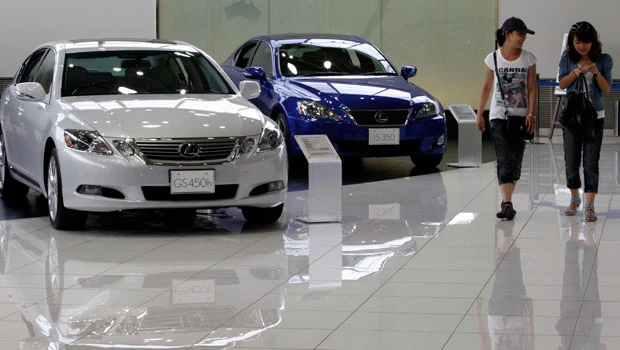
- DUBAI: Car sales in GCC states will rise by low single digits this year, far below forecasts, hampered by regional unrest and supply disruptions after Japan’s earthquake.
Tougher lending rules in the UAE, the No. 2 Gulf market with over 238,000 new passenger cars sold in 2010, are also expected to dent sales.
Some 1.2 million cars are forecast to be sold in the six Gulf states this year, a 4.5 percent rise from 2010 but below the 12.2 percent jump predicted by industry watcher IHS Automotive before the Japan disaster .
New vehicle sales grew 12.5 percent to over 1.1 million last year in the world’s top oil exporting region, where Japanese brands account for around 60 percent of the market, IHS said.
“There are some numbers already which are showing problems with the supply. Given the high share of Japanese car makers in the GCC, there is not much other choice,” said Pierluigi Bellini, manager for EMEA vehicle sales forecasts at IHS Automotive in Milan.
“Sales are not going to go back to what they would be without the Japanese crisis. But ... by the end of the summer the stocks at dealers will start to be filled again.”
Toyota Motor, the most favored brand in the Gulf, saw exports plunge by 63 percent in May from a year earlier in the aftermath of the March earthquake, tsunami and subsequent power cuts.
Japan’s car exports to Saudi Arabia and the UAE, which combined account for 72 percent of the Gulf auto market, slumped 78 percent and 65 percent in April-May, respectively, data from Japan Automobile Manufacturers Association showed.
“I saw some drops in Japanese sales ... due to the supply,” said Michel Ayat, general manager at Dubai-based Arabian Automobiles, which is selling Nissan among other brands.
“But starting from the third quarter, the supply will come back to the same level as before the tsunami disaster,” he said.
Toyota, Nissan Motor and Honda Motor, Japan’s top three automakers, have all said they are close to being able to build as many cars as they had planned before the quake, with only a few critical components still affected.
“The key is how quickly Japan has bounced back,” said Simon Frith, managing director at Al-Futtaim Motors, a Toyota and Lexus dealership in the UAE.
“We were expecting production to be hit right up until October, November this year. But we are almost back on every model to normal production now,” he said.
Official car sales data in the Gulf are not available.
Growth in most Gulf economies is expected to accelerate this year — to 5.7 percent in the case of Saudi Arabia — on high oil prices and government spending aimed at quelling social tensions, helping to drive car sales higher.
However, in the UAE, sales may be dampened by bank reluctance to lend after Dubai’s debt crisis and new central bank rules aimed at curbing the excesses of the oil-boom years.
“The banks are very cautious,” said Soncy Antony, retail operations manager at Western Auto Trading in Dubai.
“Earlier, if you had a (monthly) salary of 2,000 ($545) or 2,500 dirhams, you used to get financed from the bank. Nowadays, under 5,000 or 6,000 you don’t.”
In February, the UAE central bank came up with new lending rules, which capped car loans at 80 percent of the financed vehicle value and put the maximum repayment period at 60 months. The personal loan limit was set at 20 times the monthly income.
“The first anecdotal evidence seems to point toward a steep slowdown (in car sales) after the measure was implemented on May 1,” said Philippe Dauba-Pantanacce, MENA senior economist at Standard Chartered.
“But this could prove to be temporary as ... both car buyers and dealers adapt to the new rule.”
At Arabian Automobiles, around 80 percent of customers buy new cars with bank financing, Ayat said.
IHS forecasts car sales in the UAE to grow by 7.1 percent to 255,325 this year, down from a 15.8 percent jump in 2010.
Bahrain, which saw its worst public unrest since the 1990s in February and March, is the only Gulf market expected to see a decline in car sales of 37.6 percent to 32,766 in 2011 after 30.9 percent growth last year.