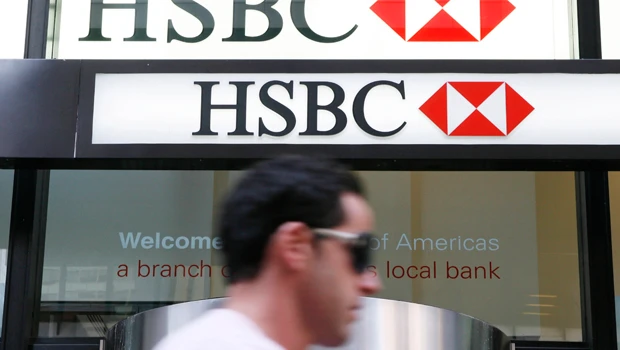
- LONDON: HSBC will shed 30,000 jobs as it retreats from countries where it is struggling to compete, Europe’s biggest bank said after reporting a surprise rise in first-half profit.
Shares in HSBC rose as much as 5 percent as it unveiled first-half pretax profits of $11.5 billion, up from $11.1 billion a year ago and better than the $10.9 billion average in a Reuters poll of analysts.
The bank also said it had cut 5,000 jobs following restructuring of operations in Latin America, the US, Britain, France and the Middle East and that it would cut another 25,000 between now and 2013.
“There will be further job cuts,” Chief Executive Stuart Gulliver told reporters on a conference call. “There will be something like 25,000 roles eliminated between now and the end of 2013.”
The cuts equate to roughly 10 percent of HSBC’s total work force. They come on top of any reductions in overall headcount that will result from a program of disposals that also forms part of a plan to focus on HSBC’s Asian operations.
“It’s a big number, but it makes sense because HSBC’s costs are fairly high,” Daniel Tabbush, analyst at CLSA in Bangkok, said of the staff cuts. “Hopefully these cuts help make an impact in helping lower the bank’s cost-to-income ratio.”
HSBC said many of the losses would come through natural wastage rather than enforced redundancies and some of the impact would be offset by creating jobs elsewhere, with new ones already created in Asia, Brazil and Mexico in the first half.
But Britain’s Unite trade union said the worst fears of HSBC staff had been confirmed.
“Today while the bank reports strong profits of 7 billion pounds, its staff face an uncertain future as the management press forward with this brutal restructuring,” Unite national officer David Fleming said in a statement.
HSBC is reversing a strategy that had been criticized for “planting flags” around the world.
Gulliver’s overhaul, first unveiled three months ago, aims to slash costs and scale back the bank’s global spread.
HSBC said on Sunday it would sell 195 US branches to First Niagara Financial for about $1 billion in cash, and close another 13 of the 470 sites it had.
HSBC also intends to sell its US credit card portfolio, which has more than $30 billion in assets, a move which would free up capital. Capital One Financial Corp. and Wells Fargo are among the bidders, sources have said. Another suitor could be Barclays.
“We still have a number of people interested in that business. If we can’t get the price we’re looking for we have a number of options — we can run it off, sell it in pieces, we could decide to keep the retail private label cards,” Gulliver said.
Gulliver indicated, however, that the geographical spread of its cut backs would be less radical than first envisaged.
The bank now aims to shut or sell retail operations in a further 20 countries. In May, he had earmarked leaving 39 countries but has so far only closed in Russia and Poland and shrunk its business in the United States.
HSBC is the first of Britain’s big banks to report this week. Rivals are also cutting jobs and shaking up their business model as the euro zone debt crisis has hit fixed income trading revenues hard and tougher regulations are hurting returns for investors.
The bank highlighted risks to global economic recovery from increased regulation, particularly as governments grapple with sovereign debt crises and try to plug holes in their budgets.
“The pace and quantum of regulatory reform continues to increase at the same time as the global economy appears to be losing momentum in its recovery,” HSBC said.
Shares in HSBC were up 5 percent at 624.1 pence and hovering around a three week high at 1027 GMT, making them the second strongest performer on the blue-chip FTSE 100 index and valuing the group at around 110 billion pounds ($180.6 billion).
Analysts at Canaccord Genuity said HSBC’s profits had been broadly in line with their expectations but that stronger than expected revenue numbers indicated the bank was likely to outperform in the near term.
The earnings rise at HSBC was driven, in part, by a big improvement in the ability of its customers to meet loan repayments with losses on bad loans down 19 percent on the previous six months and 30 percent better than a year ago.
That improvement drove a 131 percent rise in profits for retail banking and wealth management. Profit rose 31 percent at is commercial banking division with customer lending up 12 percent versus the end of last year. Global banking and markets profits fell 12 percent.
“They’re reasonably reassuring numbers but they’re still pointing toward concerns about the global economy,” said Colin McLean, managing director of SVM Asset Management which owns HSBC stock.
Gulliver said that across Asia-Pacific he was reasonably confident emerging markets would continue to show robust growth.
“We’re pretty confident China will manage a soft landing and we’re confident the overheating that appears in pockets of the property market, especially here in Hong Kong, will be ably dealt with by the authorities,” he told reporters.