
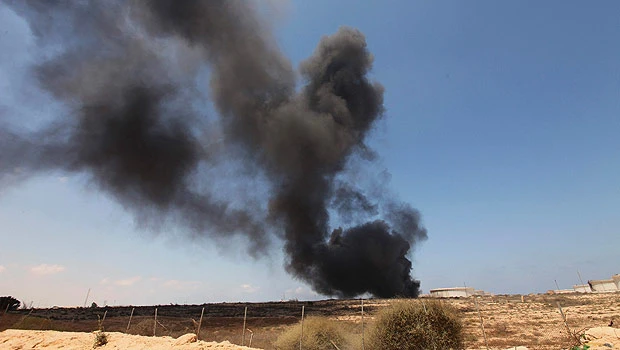
- BENGHAZI: Libya’s largest oil refinery, Ras Lanuf, is intact despite intense fighting between rebels and Muammar Qaddafi’s troops, and staff are preparing to restart operations, its general manager said.
- The oil town of Ras Lanuf was until a few days ago under the control of Qaddafi’s forces and the front line is only about 25 km to the west.
Rebel oil company AGOCO said earlier that all five of the country’s refineries were shut because of a lack of crude supply and damage to facilities, leaving the country reliant on imported fuels.
“Since February we have been shut down. We are now planning to restart the complex. We are ready to start,” Nagib Burweiss, general manager for the refinery at the Ras Lanuf Oil and Gas Processing Company (RASCO) said late on Saturday at the firm’s office in Benghazi.
He did not give a precise estimate for when the facility, which has the capacity to refine 220,000 barrrels per day, would be back in operation.
It can take days to restart a refinery that has been completely shut, and sometimes many weeks to reach full capacity.
Asked about damage to the facility, Burweiss said: “There is minor damage to two tanks from a bomb but we can use other ones.”
He did not specify whether the damage had been caused by the aircraft of deposed leader Muammar Qaddafi or NATO.
“The only other problem is that Qaddafi took our tugboats but we can rent,” Burweiss said, adding that they were probably used to shuttle arms along the coast.
The refinery is fed from the eastern fields of Mesla and Sarir, operated by AGOCO, which were damaged by Qaddafi’s troops. Burweiss said those repairs had been completed.
Still, Ras Lanuf will only go so far toward meeting the immediate needs of the population as it lacks the necessary processing units to make the most prized of oil products, gasoline.
“We can’t produce gasoline,” Burweiss said, but added the refinery had stockpiles of vital refined products such as liquefied petroleum gas (LPG), used for cooking, and diesel. He estimated volumes at 5,000 tons of LPG and 8,000 tons of diesel.
Burweiss said the refinery would also begin exporting surplus fuels, such as the petrochemical feedstock naphtha, as soon as the refinery restarts. He said contracts for exports from the refinery would be determined by the National Oil Company (NOC).
“It’s the same people in the NOC that we used before so they can decide on the contracts.”