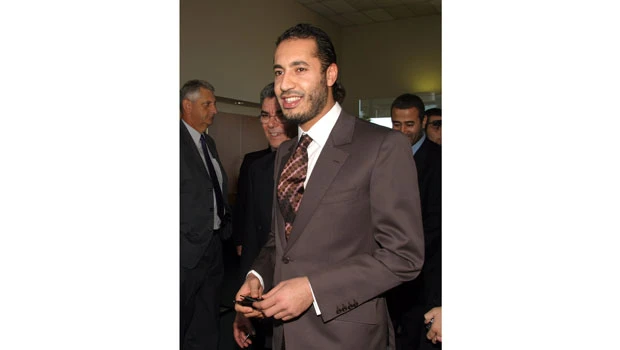
- CAIRO: One of Muammar Qaddafi’s sons has offered to surrender and join the movement, which ousted his father if his security is assured, a Libyan military commander said in remarks broadcast by Al Jazeera television on Wednesday.
Abdel Hakim Belhadj, the chief of anti-Qaddafi forces in Tripoli, said Qaddafi’s son Saadi had contacted him offering to surrender and that he plans to follow up on the offer.
“Today I had a phone conversation with Qaddafi’s son, Saadi, where he asked to be part of the revolution and to get guarantees to come back to his people and to Tripoli,” according to an English voice-over of an interview conducted by Al Jazeera with Belhadj in Arabic. “He hinted to us his whereabouts and we will be in contact with him to follow up on this matter,” he added.
Later, Saadi told Al-Arabiya TV that he contacted the rebel commander to offer talks to stop the bloodshed. He claimed he is officially empowered to negotiate with the anti-Qaddafi forces.
Qaddafi’s Foreign Minister Abdelati Obeidi was arrested on Tuesday at his farm in Janzour, a suburb west of Tripoli, a correspondent said. Forces for the ruling National Transitional Council shouted “Allahu Akbar” as they arrested Obeidi, who was wearing traditional Libyan clothes.
Meanwhile, NATO said its planes bombed Qaddafi forces near Sirte on Tuesday, targeting tanks and other armored vehicles as well as military facilities. They also hit targets in the area of Bani Walid, another Qaddafi stronghold 150 km southeast of Tripoli. Freedom fighters said on the same day that they had advanced to within 30 km of the desert town.
Libya’s new military commanders are using informants from among Qaddafi’s entourage to track down the fugitive leader, while tightening the noose around his last strongholds to force them to surrender. Hisham Buhagiar, a senior official in the military body behind Libya’s ruling National Transitional Council, is coordinating efforts to hunt Qaddafi.
Buhagiar said he believed Qaddafi was either in the Bani Walid area, southeast of Tripoli, or in his hometown of Sirte, 450 km east of Tripoli. “There are some groups who are looking for him and also trying to listen to his calls. Of course he doesn’t use the phone, but we know the people around him who use the phones,” he said.
“Usually we trace a lot of people who are not in the first inner circle with him, but the second or third circle. We’re talking to them,” said Buhagiar. “Some of them know that the regime is falling, and they want to make sure they don’t get hurt ... They want to strike deals. That’s why we’ve created the white list. Everyone who helps us is on the white list.”
World leaders meet in Paris on Thursday to discuss Libya’s future, with hosts France and Britain hoping to show that a costly military campaign can lead to a political transition that avoids the mistakes of Iraq. Big powers, gathered to coordinate the political and economic reconstruction of the oil-producing North African state, will also be jostling over business interests there.