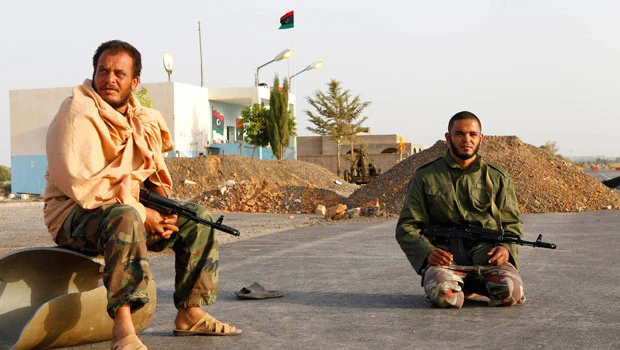
- TRIPOLI: Libya's National Transitional Council has evidence Muammar Qaddafi bought arms from companies in China and Western countries in defiance of UN sanctions and now plans legal and diplomatic action, a military spokesman said in Tripoli Monday.
"We'll be going through legal channels, through international courts, as well as the United Nations itself," Abdul Rahman Busin told Reuters. "Either to prosecute them or to come to a diplomatic understanding."
He did not specify further what action might be taken against firms, individuals or states involved in any smuggling.
"We have gathered evidence from many sources, including the main documents that were gathered here in Tripoli, that point the finger at several countries that had been supplying Qaddafi with weapons and arms, as well as intelligence officers," he said.
"They had their own mercenaries who were helping them, but whether the mercenaries were directly linked to governments or (were) private individuals is still unclear," Busin added.
Earlier Monday, China responded to the publication by a newspaper of documents that appeared to show Chinese state firms offered Qaddafi weaponry by confirming some staff had met Libyan envoys in July but without the government's knowledge.
"We've been gathering information for months now," Busin said. He declined to name the nationalities of those suspected of trying to supply Qaddafi but confirmed some were Chinese and that the proposed route for imports passed through Algeria.
Asked if Westerners also offered arms, he said they did.
It was unclear whether any Chinese weapons reached Libya.
Busin said: "The documentation ... specified the quantities, amounts, types and the route for it to come in, which was through Algeria. The total price of the actual order was near $200 million."
He said it included arms that are familiar from the Libyan war, including ammunition, pistols, automatic rifles, rocket-propelled grenades, mortar rounds and rockets.
"It was a very long list," he said.
Asked which firms were involved in selling weapons to Qaddafi, he said he did not know but believed it would be possible to identify them: "We don't actually have a list of companies. But there are only so many companies in the world that produce arms still. That narrows it down quite a lot."
A key issue for China and other countries which did not join the Western-led drive to support the uprising in Libya is whether the new authorities may penalize them in the awarding of oil and reconstruction contracts.