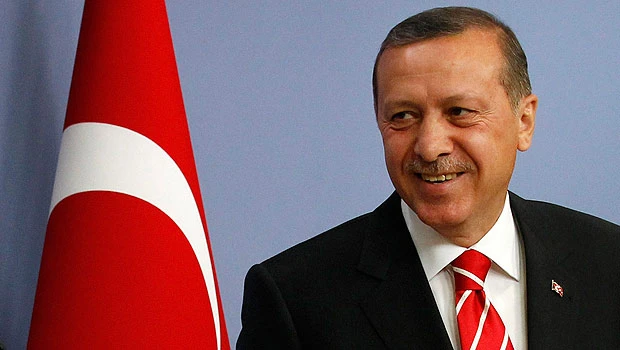
- ANKARA: Turkish Prime Minister Tayyip Erdogan refused to back down in a row with Israel Tuesday, accusing his country’s former allies of behaving like a “spoilt child” and threatening to visit the Gaza Strip.
As Israel said it wanted to avoid relations worsening, Prime Minister Recep Tayyip Erdogan confirmed a halt to all military cooperation and that Turkey’s navy would conduct more high-profile patrols in the eastern Mediterranean.
Erdogan’s threat to send warships into waters where Israel’s navy operates raises the risk of a naval confrontation between the two powers.
“The eastern Mediterranean is not a strange place to us. Aksaz and Iskenderun — these places have the power and opportunity to provide escorts,” Erdogan said in Ankara, referring to two Turkish naval bases.
“Of course our ships will be seen much more frequently in those waters.”
Erdogan also plans to visit Egypt on Sept. 12-14 to discuss political coordination and economic ties, an Egyptian government official said.
Some media reports had suggested Erdogan would travel from Egypt to Gaza, but the Egyptian official said he did not expect such a trip to take place.
Erdogan will also attend the UN General Assembly in New York later this month where he is likely to give strong backing to Palestinian efforts to win UN recognition for a state they aim to create in Gaza and the occupied West Bank.
Turkey announced last week that the Israeli ambassador Gaby Levy was being expelled and all bilateral military agreements were suspended as it angrily rejected the findings of a UN probe into the deadly flotilla raid.
Now in his first official reaction since that announcement, Erdogan went even further.
“We are totally suspending our trade, military, defense industry relations,” he said.
His office later clarified however that Erdogan did not mean a suspension to commercial ties in general but merely “in the defense industry area.”
“We suspended all military agreements, especially the commercial ties in defense industry,” Erdogan said later Tuesday in a press conference with his Spanish counterpart Jose Luis Rodriguez Zapatero.
“We have taken the first steps. These are not final,” Erdogan added.
Ties with Israel began to unravel after Erdogan voiced outrage at an Israeli offensive against the Gaza Strip in late 2008 and early 2009.
Asked about Erdogan’s remarks, an Israeli government official said: “Israel does not want to see further deterioration in its relationship with Turkey.”
Turkey has also taken issue with the UN panel’s conclusion that Israel’s blockade is a legitimate measure to stop weapons reaching Hamas militants in Gaza.
Erdogan said Turkey was preparing more sanctions against Israel, and specifically said defense industry ties would be frozen.
“Trade ties, military ties, regarding defense industry ties, we are completely suspending them. This process will be followed by different measures,” Erdogan said.
An official at Erdogan’s office said the prime minister was referring to military and defense trade ties only, not overall trade, which last year reached a total bilateral volume of $3.5 billion.
Economy Minister Zafer Caglayan said earlier Turkey would do nothing “for now” to change its economic ties with Israel.
Turkish media reported that Erdogan held a meeting with Turkey’s chief military commander, General Necdet Ozel, to discuss developments with Israel.
Some Turkish and Israeli commentators have suggested Turkey might use the feud with Israel to build up naval patrols in seas between the Jewish state and Cyprus.
Turkey has bitterly complained about recent Cypriot-Israeli energy deals and the presence of Turkish ships would have a menacing effect.
Asked about exploratory drilling for natural gas by Greek Cypriots, Egemen Bagis, Turkey’s European Union minister, told Turkish media last week: “It is for this (reason) that countries have warships. It is for this (reason) that we have equipment and we train our navies.”
Israeli Defense Minister Ehud Barak, in remarks broadcast before Erdogan’s announcement, urged the two states to act with calm.
“Israel and Turkey are the two strongest and in many respects the most important countries in the Mideast. We have our differences, but in differences too it is important that both sides act using their heads and not their gut — that will be best for us all and best for regional stability and restoring things,” said Barak.
The US expressed concern Tuesday over the diplomatic row between Turkey and Israel, urging them to “de-escalate” their dispute.
“We are concerned,” said State Department spokeswoman Victoria Nuland after Ankara raised the stakes by announcing it was suspending military and defense industry ties with Israel.
US Secretary of State Hillary Clinton raised US concerns about the row in Paris with Turkish Foreign Minister Ahmet Davotoglu. And the US has had discussions with the Israelis about it in recent days, Nuland said.
“Our emphasis with both the government of Turkey and the government of Israel is to hope that we can de-escalate, we can defuse, and we can get them back to talking about improving their relationship,” she said.
“There are freedom of navigation issues for both Turkey and for Israel. But we want to avoid future confrontations, and we want both of these strong allies of the US to get back to a place where they have a good working relationship with each other,” she said.