
- <I>Celebrating works inspired by the Islamic world around the globe<br /></i> The Victoria and Albert Museum in South Kensington, London has been home to a vast collection of Islamic art for more than 150 years.
- Today, the Museum has taken a step beyond simply showcasing it, they have joined efforts with the Abdulatif Jameel Group’s Community Initiative to highlight and encourage work inspired by the faith.
The Victoria and Albert Museum in South Kensington, London has been home to a vast collection of Islamic art for more than 150 years. Today, the Museum has taken a step beyond simply showcasing it, they have joined efforts with the Abdulatif Jameel Group’s Community Initiative to highlight and encourage work inspired by the faith. The Jameel Prize is a biennial award recognizing the use of Islamic design and art technique in contemporary work.
Inaugurated in 2009, it is now in its second run. The criteria is broad, the panel is in search of contemporary artists and designers inspired by Islamic art, craft and design. The open aspect of the call for works, however, has been a great advantage. “Giving a criteria and letting the artists respond is why we have a completely different array of artists,” explains Salma Tuqan, Middle East curator of contemporary art at Victoria and Albert. “The works really speak for themselves. They show an understanding of Islamic techniques and traditions while responding to them in innovative ways that are relevant and new.”
The main mission of the Jameel Prize is to create a platform for artists and designers and emphasize Islamic art’s significance, showing that it does indeed still produce bold contemporary work. The Prize does not discriminate religious backgrounds, age groups or geographic base. Open to any person inspired by Islamic art and design practice the 2011 short list consists of six women and four men, ranging in age group from late-20’s to late-80’s, from countries as far apart as the US, Canada, Pakistan, Egypt, Iran and Algeria.
The differences between this year’s collection and that of 2009 are apparent. While 2009 included a number of graphic and pop art work, including pieces by Iranian artist Khosrow Hassanzadeh and London-based Moroccan photographer and designer Hassan Hajjaj, the 2011 collection has a more meditative feel to it.
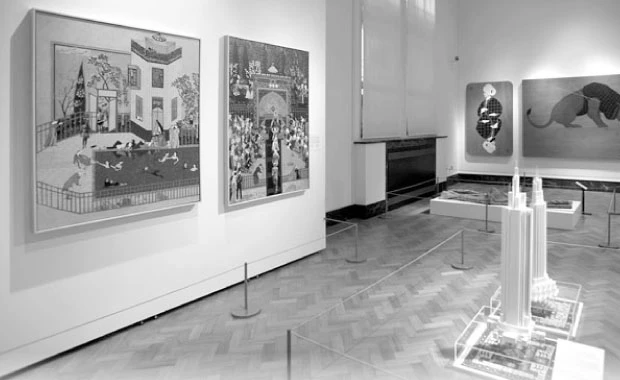
A number of the works express ideas about hybrid cultures in pensive and socially pertinent ways. Hayv Kahraman is an Iraqi artist living in San Francisco. Using oil paint on large panels of wood, she creates images inspired by playing cards created for the US soldiers in Iraq to identify sites of archeological importance in order to avoid their destruction. Two of the panels, part of the Migrant series, deal with dichotomies of her own family’s experience moving from Iraq to the United States. “With the playing cards, you have characters who are bound. You can see that one character is holding the hand of the other, they are part of the same person but they are torn. It is those questions of identity and turbulence, being pulled from your homeland and not quite fitting in to the new places that Kahraman works with,” Tuqan explains. Kahraman’s study of psychology and interviews with Iraqi diaspora in the United States add depth to her depiction of these dualities.
This year’s shortlist has also had a focus on material-based production making the idea of the ‘handmade’ palpable. Among these is the intricate mirror mosaic of Monir Shahroudy Farmanfarmaian. Her work aims to discover new shapes and colors by continuously studying and reinterpreting ancient forms of ornamentation to create modernist pieces. On display is Birds of Paradise, inspired by feathers she found in her balcony in Tehran. Using reverse glass painting technique popular in the 1800s, she created a technically awe-inspiring mirror mosaic that retains a traditional aesthetic.
Another piece displaying the material-based works is Felt Memories by Bita Ghezelayagh. It clearly demonstrates difference in traditional craftwork through a felt tunic in contrast to the contemporary photo-imprinted medallions stitched onto it. While Ghezelayagh’s use of the traditional items of clothing represents her Iranian childhood, the emblems attached refer to her pop-culture influences and symbols of resistance and martyrdom. “That piece is housed where the Uzbek textiles usually are. I’ve been in there many times watching people pass it by seamlessly thinking that it is an artifact as well. It is part of nomadic tribes, its part of heritage, part of society but at the same time when you look closely there are the elements of embroidery, the painted on tulips and post-revolutionary icons all threaded on,” Tuqan adds.
Among the most fluid pieces is Babak Golkar’s piece Negotiating the Space for Possible Coexistence no. 5, which combines both material production and cultural hybridity. Golkar is American of Iranian parents currently living in Canada. His piece connects the complexities of Islamic traditions through the patterns found on Persian rugs to the contemporary world through architecture of a North American megacity. Using the intricate shapes within the rug as a base, he constructs model buildings. His works explore the spaces between cultures, conceptually examining them through various dimensions of the shapes and patterns. The piece on display uses North Iranian carpets sourced from a bazaar in Istanbul. Using his words, Tuqan explains, his ‘moment of alchemy’ where “the piece transforms from three-dimensional to two-dimensional. Golkar sees that the piece is in flux; it has a fluent nature about it, there is no one origin to the work — not the carpet nor the cityscape, it’s a constant state of transition.”
With an already-established network, the Prize has prioritized open inclusivity. Still yet, the Jameel Prize is working toward growth. “Expanding the network of nominees is really important,” Tuqan explains. “We’re now looking at networks in Latin America and Africa.”
While the Jameel Prize celebrates works inspired by the Islamic world, the Prize display and activities are headed out of London, emphasizing its global position. In this sense, London and the Victoria and Albert Museum play the part of nucleus to the said established network. Judges on the panel include Wassan Al-Khudairi, director of Mathaf: Arab Museum of Modern Art in Qatar; Dina Bakhoum, conservation program manager at the Aga Khan Trust for Culture in Egypt; and the 2009 Jameel Prize winner, Afruz Amighi who is based in New York City. After the announcement of the winner, the collection begins its long tour as an exhibition coupled with educational events with an itinerary of cities including Paris, Houston, Riyadh, Damascus, Sharjah, Istanbul and Casablanca among others. Tuqan emphasizes the educational aspect of the Prize’s display, “With the international tour it is important that we aren’t just taking it to venues as a traveling exhibition. It will be responding to a very strong educational program.” The educational aspect is also a big part of the London display. While the 2011 winner will be announced September 12, there is a week-long series of events commencing on the 11th that will include artists’ presentations, Q&A sessions with curators, screenings of films about the works, and workshops.
Bringing this creative production to a mass global audience has shared complexities and universalities of Islam through art inspired by it. The exhibition of ten artists and over 20 works is uplifting, reflecting a strength in the determination that is clearly part of the intricate production process expressing emotional and intellectual, collective and personal ideas.