
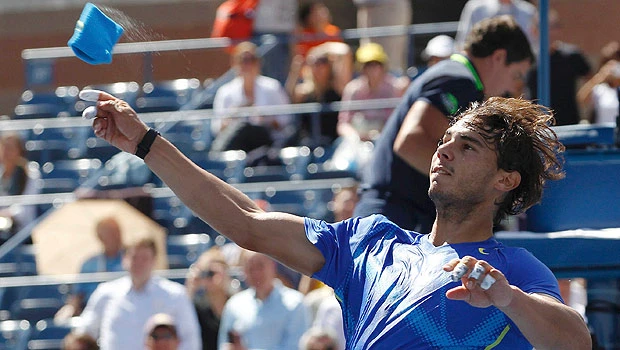
- NEW YORK: Defending champion Rafael Nadal took out his US Open frustrations on Gilles Muller of Luxembourg on Thursday to reach the quarter-finals with a 7-6 (7/1), 6-1, 6-2 victory.
The second seed had trailed 0-3 overnight after just 15 minutes of play had been possible on Wednesday, but with bright sunshine replacing two days of heavy rain, the Spaniard raced into the last eight.
Next up for the champion is either 21st-seeded American Andy Roddick or Spanish compatriot David Ferrer for a place in the semifinals.
"It was a tough day yesterday for the players and the fans who waited many hours. Sorry about that, but thanks for still being here," said Nadal.
"After the last two days, I am happy to be through. I played well against a very tough player.
"The situation yesterday was not easy for us and the organizers. They tried their best but they were wrong. Everyone makes mistakes."
Nadal has endured a dramatic US Open, collapsing with cramping at a news conference after his third round win over David Nalbandian before his frustrating two days waiting for the rain to clear.
He made up for lost time on Thursday, taking less than two hours to complete victory over the 68th-ranked Muller who he had also defeated at Wimbledon this year.
Breaks in the second and fourth games of the second set proved enough for a comfortable lead and he was quickly 2-0 up in the third.
Muller, the junior champion in New York 10 years ago, retrieved the break for 2-1 but further breaks for Nadal in the fifth and seventh games put the tie beyond his opponent's reach.
Victory was secured after 2hrs 08min with a smart backhand volley.
Britain's Andy Murray also charged into the quarterfinals with a 6-2, 6-3, 6-3 win over American wildcard Donald Young.
The world No.4 wasted no time booking his place in the last eight after the previous two days at Flushing Meadows were washed out by rain, wrapping up the victory in just under two hours.
Murray's next opponent will be either Frenchman Gilles Simon or big-serving American John Isner with defending champion Rafa Nadal looming in the semifinals.
Murray faces the daunting prospect of having to win four matches in four days to win his first grand slam title.
Earlier, Andy Roddick stormed off court in anger on Thursday after his match against David Ferrer of Spain was suspended because of a water-logged playing surface.
In bright sunshine, Roddick and Ferrer played just two more games of their clash, which had already twice fallen victim to the weather, on Louis Armstrong Stadium when play was halted as water seeped up to the court surface following more heavy overnight rain.
After court staff and officials tried to dry up the wet patches behind the baseline, the players were called back to the court, but Roddick told tournament referee Brian Earley that the surface was still too wet to play.
"Why are we here if there is water there?" stormed a furious Roddick.
Nadal and Murray led a protest Wednesday night as the leading players voiced their anger at being forced to play on wet courts, which they said were dangerous. As rain drenched here for the second day in succession, long-standing resentments by some of the players came to the surface. Brad Gilbert, Murray's former coach, said it was "hopefully a watershed moment when the players can come together." By the time the men's singles matches were called off for the day shortly after 5pm only a quarter of an hour's play had been possible, which was at least more than the previous day's wash-out. The players were sent out to play at 12.30pm during a brief dry spell. They complained that the surface was wet and slippery and rain forced them off within a quarter of an hour.
Donald Young was leading Murray 2-1 on Grandstand Court, Nadal was trailing Gilles Müller 3-0 in Arthur Ashe Stadium and Andy Roddick was leading David Ferrer 3-1 in Louis Armstrong Stadium. Nadal was said to have told officials as he left the court: "It's the same old story. All you think about is money." Nadal went immediately to complain to Brian Earley, the tournament referee, and was joined by Murray and Roddick. "We don't feel protected," Nadal told ESPN afterwards. "Grand Slams earn a lot of money and we are part of the show. They are just working for that, not for us. They know that it's still raining and they call us on court. That should not be possible.
"The court was dry for 10 minutes, but they knew that we would have to come off after 10 minutes. Yet they still put the players on court. We understand the fans are there, but the health of the players is important." Murray said the surface had been dangerous. "When we went out on the court it was still raining," he said. "The back of the court was soaking wet and the balls were really wet too. Everyone that I spoke to mentioned it to the umpire and they just said: 'No, it's fine.' But it doesn't really make sense to try and go out for seven or eight minutes and then have to come back inside." Roddick was asked by Murray if he wanted to join him and Nadal in their meeting with Earley. "I think it probably hits home a little bit more when there are three of us in there as opposed to one," Roddick said. "I certainly understand they need to put tennis on TV and I understand the business side of it as well, but I think first and foremost the players need to feel comfortable and safe." John McEnroe sympathized with the players. "Rafa Nadal is one of the all-time greats," he said. "He's trying to defend his US Open title. What the hell difference does it make whether he comes out at 12 or 12.10?" Players have long complained about the scheduling of matches here, particularly as there are no roofs or even tarpaulins to protect the courts. Not only do the men dislike the fact that the semifinals and final are played on successive days on the concluding weekend, but they also believe the scheduling can adversely affect those in the half of the draw who play a day later than their rivals.
If the tournament has been unlucky in the last four years — the conditions are usually fine until the latter stages — the weather is not unprecedented. Between 1968 and 1974 competition had to be extended into a third week on four occasions.
The United States Tennis Association have compounded the meteorological problems with their match scheduling, which is geared to the demands of television, and their failure to install a roof.
At Wimbledon, players in both halves of the draw are scheduled to play on the same day from the fourth round onwards, but here the two sections do not come together until the semifinals.