- BENGHAZI: For the past few days, the inhabitants of Benghazi, the cradle of the Libyan revolution, have been called on in the media and in pamphlets to turn up in their tens of thousands to a demonstration on Friday in the city’s main square.
- It is named the “Million Demonstration.”
The hope is that a million people will turn up although that has to be somewhat optimistic given that the entire population of Benghazi is one million. The brief presence in the city of French President Nicolas Sarkozy and British Prime Minister David Cameron on Thursday is also bound to overshadow the event.
The objective of the protest is three “Noes” — no to centralization (that is a unitary state controlled from Tripoli), no to ex-Qaddafi figures such as his former Prime Minister Abdussalam Jalloud being given positions in the new government, and no to political and religious opportunists trying to steal the revolution.
The date of the demonstration is significant. This year, Sept. 16 marks the 42nd anniversary of first speech in Benghazi by Libya’s fugitive ex-leader Muammar Qaddafi. More importantly, it is the 80th anniversary of the hanging by the Italians of Libya’s great freedom hero Omar Mukhtar, who for almost two decades until his capture in 1930, was a deep thorn in the Italian colonizers’ side. The location of the demonstration reflects that.
Today the main square is a large dirty space, empty but for a few dying plants, and with the Benghazi traffic rushing past. In the past few weeks it has been renamed Martyr’s Square in honor of the tens of thousands who have died in the Libyan uprising. It used to be called Maidan Darih, Mausoleum Square or simply Omar Mukhtar Square. Until 2000, the mausoleum of Omar Mukhtar stood there.
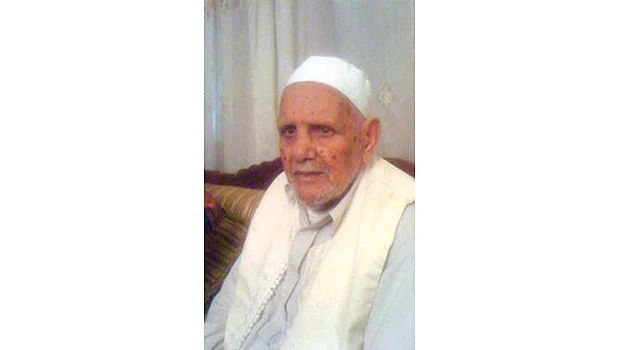
In a simple house on a main street in Benghazi, Omar Mukhtar’s only son, Haji Mohamad Omar Mukhtar, offers tea as he tells the story of what happened to it.
It was erected with the approval of the Mukhtar family eight years after Libyan independence by King Idris, who had headed the Senussite forces which Omar Mukhtar led against the Italian forces. Idris wanted to honor his former friend and colleague, whose body had initially been buried in distant Sidi Abeid. Thus in August 1960 it was moved to its new location to become, in effect, Libya’s national memorial. It was a major event. “Visitors came for the ceremony, some from Egypt and elsewhere,” explained the 90-year-old Haji Mohamed. Thereafter, foreign dignitaries when visiting the city would come and lay a wreath there.
Qaddafi had tried to enlist the memory of the schoolteacher-turned-freedom fighter to serve his own political agenda. While most streets in Libya’s towns and cities were renamed to fit his political inclinations, those bearing Omar Mukhtar’s name survived. He put Omar Mukhtar’s face on Libya’s 10-dinar note (but his own on the far more common one-dinar note). And he bankrolled the $30-million dollar Hollywood blockbuster “Lion of the Desert” but forbade all mention in it of the Senussis, for whom Mukhtar fought. Qaddafi so hated them he had the bodies of the Idris’ ancestors dug up and their bones cast into the desert.
A less drastic fate was accorded the remains of Omar Mukhtar. Forty year after being interred in the mausoleum, a resentful and jealous Qaddafi had them removed to the village of Soluq, some 60 km from Benghazi. The order reveals a story of paranoia, despotism and petty-minded vengeance worthy of a Nero or a Caligula. It also speaks of Qaddafi’s delusions about his own self-importance. He had Omar Mukhtar re-buried near his own father’s grave.
What triggered the removal of the body and tomb was football. Benghazi had Libya’s oldest team, Al Ahly, founded by members of the Senussi movement linked to Omar Mukhtar. But just as there are other teams in the Arab world of the same name, so too one was established in Tripoli and it had a powerful supporter — Qaddafi’s passionate but mediocre footballer son Saadi. Being his father’s son allowed him both to captain the Tripoli team and to fix matches in its favor.
The dispute over the name brought the Benghazi team into Saadi’s particular disfavor and he set out to make it suffer. At its matches, referees would award penalties to the opposing team; good players were poached by other clubs. By 2000, the Benghazi fans had had enough. Defeated in a decisive relegation match thanks to another highly dubious penalty award by the referee, the fans took to the streets. They dressed up a donkey in Al Ahly Tripoli’s colors, putting Saadi’s number on it.
The Qaddafis’ fury was instant and ruthless. Fans were arrested and imprisoned. Three were condemned to death although the sentences were not carried out. A few weeks later, on Sept. 1, the anniversary of Qaddafi’s seizure of power, the club was closed and bulldozers were sent in to destroy its offices and training grounds. At that point, the fans took to the city’s most famous monument, Omar Mukhtar’s mausoleum, to protest. “We are Omar Mukhtar’s grandsons,” they shouted, referring to the club’s connection with freedom-fighter’s movement. “We are not afraid of Abu Minyar” (the Qaddafi family surname — meaning that they were not afraid of the Qaddafi family.)
Qaddafi’s petulant response was to tear down the mausoleum and remove the body.
Unlike King Idris who had asked permission to move the body in 1960, “Qaddafi did not ask us when he did it,” said Omar Mukhtar’s son. “We did not approve of moving him to Soluq and destroying the tomb.
For the past couple of days, workmen have been busy erecting a temporary structure where the mausoleum once stood as a symbolic reminder for the anniversary demonstration. Haji Mohamed said he would attend. Every year on the anniversary of his father’s hanging he goes to where the mausoleum stood as well as visiting his father’s present grave. He would be there in the square this year, alongside the demonstrators.
From the beginning of the revolution, he has supported it. Posters of his father can be seen on buildings, walls, lamp posts, trees, cars — almost anything — across the country. It vies with the tricolor independence flag as an icon of the uprising. He is clearly proud of that fact and that those who rose up call it the “Revolution of Omar Mukhtar’s grandsons.” Three days after it started, he went to what is now called Freedom Square, in front of the High Court, to join the throng calling for Qaddafi’s overthrow. While fighting was going on near Ajdabiyah, he twice visited the front lines to encourage the anti-Qaddafi forces and visited the injured in hospitals. A very energetic 90-year-old.
On the table in the simply furnished room where he greets visitors, a box of “Free Libya” tissues in the revived national colors of red, black and green lies on the table in front of him. On the walls are photos of his father — in the company of Italian officers with whom he was negotiating, one of his father later on in chains. He is a living link with an era long gone and whom it was a great privilege to meet. He last saw his father when he was six and admits that he remembers little about him. It was long time ago, he says, and he was very young. He was in Egypt when he father was hanged; he was sent there for his safety. He returned only in 1943 with the Senussis as an officer in the Free Libyan forces. He is, quite simply, an inspiring and lovely man who exudes great dignity — and is generous-hearted too. He holds no rancor, no hatred for what happened to his father or to the tens of thousands of Libyans who died as a result of Mussolini’s attempt to ethnically cleanse the land. Gen. Rodolfo Graziani, the man who hanged his father was, he says, a bad man “but the Italians are good people now.” Yet for all that distance in time, there appears a link in his mind between events then and now, between the photos on the wall and the Free Libya tissues in their red, black and green box. Asked whether he sees the revolution against Qaddafi as a continuation of the freedom struggle his father fought and died for, he replies with a dignified but definite “Yes”.
Libya's youth likewise see the link, which explains the omnipresence of Omar Mukhtar posters and why they call themselves Mukhtar's "grandsons". They want to reconnect with Libya's pre-Qaddafi past, knowledge of which was denied them in Qaddafi's schools. Stories about that past now fill the many newspapers now available. Libya's revolution has been won by its youth but their great supporters are their grandparents, the generation that knew Libya before Qaddafi. There seems a special bond between them in the current upheavals. For many, Haji Muhamed Omar Mukhtar is the embodiment of that link, which is why in today's new Libya he is a much loved figure.
There are now plans to rebuild the mausoleum and bring back Omar Mukhtar’s remains to Benghazi. A public appeal has been launched for funds for the project. His son approves and supports the project. It is, he says, what Libyans want.
Of that there seems no doubt.