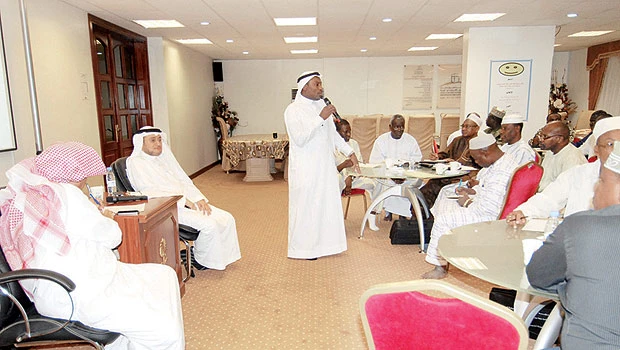
- MAKKAH: The Tawafa Organization for Non-Arab African Pilgrims has organized two workshops on the frequent transport system being implemented by Saudi authorities for the transportation of pilgrims from certain countries during the peak Haj season.
The workshops, conducted by Abdullatif Bukhari, supervisor of the system at the Haj Ministry, were attended by members of Haj missions from non-Arab African countries.
“The workshops come as part of the Tawafa organization’s early preparations for Haj in order to extend better services to pilgrims,” said Abdul Wahid Saifuddin, chairman of the organization which serves more than 175,000 pilgrims from 46 countries.
He said the workshops were attended by officials in charge of transportation at the Haj missions of Kenya, Tanzania, Senegal, Niger, Madagascar, Mali, Mayotte, Togo, Ghana and Nigeria.
“We’ll continue to hold similar workshops for officials from other countries as well as for members of the organization’s 34 field groups,” he said.
Saifuddin emphasized his organization’s desire to establish strong relations with the Haj missions in order to achieve their cooperation for providing the best possible services to pilgrims.
Abdul Rahman Mariyah, deputy chairman of the organization, said during the workshops the participants were briefed on the frequent transport system as well as the latest developments in the system.
The officials of Haj missions were also explained on how they can contribute to the successful implementation of the system, Mariyah said. Participants were also given a correct briefing about the holy sites.
The briefing came in the context of the expansion and development work being carried out in Makkah. Recently the city’s governor announced a massive project that would make Makkah a world-class city with advanced facilities and extend better services to the millions of pilgrims who come to the city.
Makkah Gov. Prince Khaled Al-Faisal emphasized that the massive SR100 billion development project, to be carried out over the next six years, should go beyond the construction of buildings, giving greater importance to hospitality to be extended to the guests of God.
“Awareness programs will be carried out to encourage Makkawis to provide pilgrims with Islamic hospitality, involving men, women and children of the city,” he said.
“If we succeed in implementing the project as planned, it would help us provide integrated services, covering reception, housing, food, transportation, health and security,” the governor said.