
- While many seem to care more about losing what they have, Diana Orabi has always cared more about gaining something new.
In her eyes, a challenge is a spur to success and a difficulty is a powerful tool. This young working mother of three daughters finds problems so infinitely ubiquitous that she believes managing problems is a vital skill.
Currently working as a manager of human Resources at Alfaisal University, Orabi who was born in Riyadh, still finds the time to pursue her passion of photography.
“I have always been attracted to art in general. I used to draw and write poems, then I stopped for years. However, I always found myself looking at people and using my eyes to frame pictures. I often thought ‘Wow! I wish I can freeze some moments,’” said Orabi.
“From that time, I began taking pictures mostly of my family and children. I even took a photography course and ended up carrying my Nikon D50 everywhere with me,” she added.
This passion reflects the singular resilience and unfaltering optimism imbedded in her character. All her photographs not only reveal her positive thinking, but they also tell a story. Orabi treats a photograph like a painting. She never duplicates a print, and each photograph is one of a kind, a unique work of art.
All Orabi’s photographs, which were presented to the public at her exhibitions at the Four Seasons Hotel (2008) and at the Panorama Hall (2011) in Riyadh, were printed on canvas. Each photograph comes with a short poem and a silver plaque, featuring where and when the photograph was taken. She also records the names of all the people who have bought one of her photographs, and she is currently working on a book that will feature all her photographs with the owners’ names.
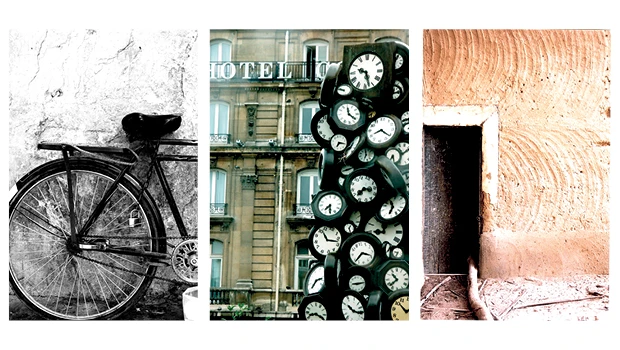
Her first photograph, which she has kept for her private collection, represents an ancient wooden door taken in Dira’iyah in the outskirts of Riyadh. Doors, windows and portraits are among her favorite subjects. Doors and windows symbolize the way out and also imply that one should never give up.
The regal “Half Bicycle,” which was shot in Syria, was deliberately pictured with a missing wheel. The missing half compels the viewer to concentrate on the details, to ask questions and find the meaning of this photograph. Would we have paid attention to the lock if the entire bicycle had been shown? The lock, which represents the never-ending problems in our lives, should be removed so that we can travel onwards, thanks to the wheel, the symbol of movement.
“Sand and Stones,” a desertscape taken outside of Jeddah, is a metaphor about life. The wind plays indefinitely with the flowing and rippling sand waves. The changing patterns, a sign of movement, highlights a stark contrast with the two seemingly immovable black rocks, a reservoir of energy, immobilized in the sand.
A number of Orabi’s photographs also feature human portraits, one of her favorite subjects:
“I found out that if you ask five different people to take a picture of the same subject, you end up with five different portraits. This reveals a lot about an individual’s personality,” she explained.
“The Girl in Salala” shows a young Omani woman walking defiantly toward a rocky hill. Although one cannot see her face, she irradiates a remarkable energy that breathes life into the bleak landscape.
Orabi, who is passionate and creative, dreams of owning her own gallery. Although she has struggled to succeed, she is proud of the way she handled the challenges and difficult times in her life. “I, never sit and cry, but move on,” she explains.
“Time Off,” a photograph taken in Paris perfectly encapsulates this way of thinking. It is about leaving the bad times and starting a new life. The photograph shows a hotel that is partially hidden behind a collection of clocks, each displaying different times. This symbolizes the different periods of our lives, both good and bad. Just like we always end up by leaving a hotel, a temporary home, we should always try to find a way out and move on during times of crisis.
“There are moments really worth capturing and keeping forever; moments that even words cannot describe. Only photos can do that. A photo, a glimpse of life frozen in time, conveys feelings and emotions in a universal language,” concludes Orabi.