- UNITED NATIONS: Palestinian President Mahmoud Abbas asked the United Nations on Friday to recognize a state for his people.
Abbas handed UN Secretary-General Ban Ki-moon a letter requesting full UN membership, which the Security Council must consider — although this may take some time.
"I do not believe that anyone with a shred of conscience can reject our application for a full membership in the United Nations and our admission as an independent state," Abbas told the UN General Assembly, which gave him a standing ovation.
"We extend our hands to the Israeli government and the Israeli people for peacemaking," the Palestinian leader said.
Abbas' statehood request reflects a loss of faith after 20 years of failed peace talks sponsored by the United States, Israel's main ally, and alarm at relentless Israeli settlement expansion eating into the land Palestinians want for a state.
It also exposes Washington's dwindling influence in a region shaken by Arab uprisings and shifting alliances that have pushed Israel, for all its military muscle, deeper into isolation.
"Our people will continue their popular, peaceful resistance," Abbas declared. "This (Israeli settlement) policy will destroy the chances of achieving a two-state solution and ... threatens to undermine the structure of the Palestinian National Authority and even end its existence."
It was the first time Abbas has spoken so starkly of the PA's possible demise, highlighting the predicament faced by a body set up as a state-in-waiting but now seen by its critics as little more than a big municipality, managing the civilian affairs of the main Palestinian cities under Israeli occupation.
Dissolution of the PA would throw responsibility for ruling all of the West Bank back to Israel as the occupying power.
Israeli and US politicians have threatened financial reprisals that could cripple the PA, the source of 150,000 jobs.
Israeli delegates stayed in the hall during Abbas' speech, which was punctuated by applause, especially when he recalled his predecessor Yasser Arafat's 1974 admonition to the United Nations: "Do not let the olive branch fall from my hand."
Minutes after Abbas' speech, Netanyahu followed him to the podium to argue that only direct negotiations can bring peace, a stance backed by US President Barack Obama earlier this week.
"I extend my hand to the Palestinian people," Netanyahu told the 193-nation assembly. "The truth is that Israel wants peace, the truth is that I want peace." However, he added, "We cannot achieve peace through UN resolutions."
The prime minister urged Abbas to meet with him Friday at the United Nations to discuss Middle East peace efforts. "Let's meet today in the United Nations. I cannot make peace alone. I cannot make peace without you," Netanyahu told Abbas, adding that "we are both sons of Abraham .... our destinies are intertwined."
Netanyahu also demanded that the Palestinians recognize Israel as a Jewish state, something they reject because they say that would prejudice the rights of Palestinian refugees.
Abbas accepts that negotiations are still necessary, but argues statehood will put Palestinians on a more equal footing. "Palestine is being reborn," he declared, saying his "courageous and proud" people were marching to an appointment with history. "And I hope that we shall not wait for long."
Hamas rejected Abbas' move as "begging" for statehood. "States are not built upon UN resolutions. States liberate their land and establish their entities," said Ismail Haniyeh, who heads the Hamas administration in Gaza.
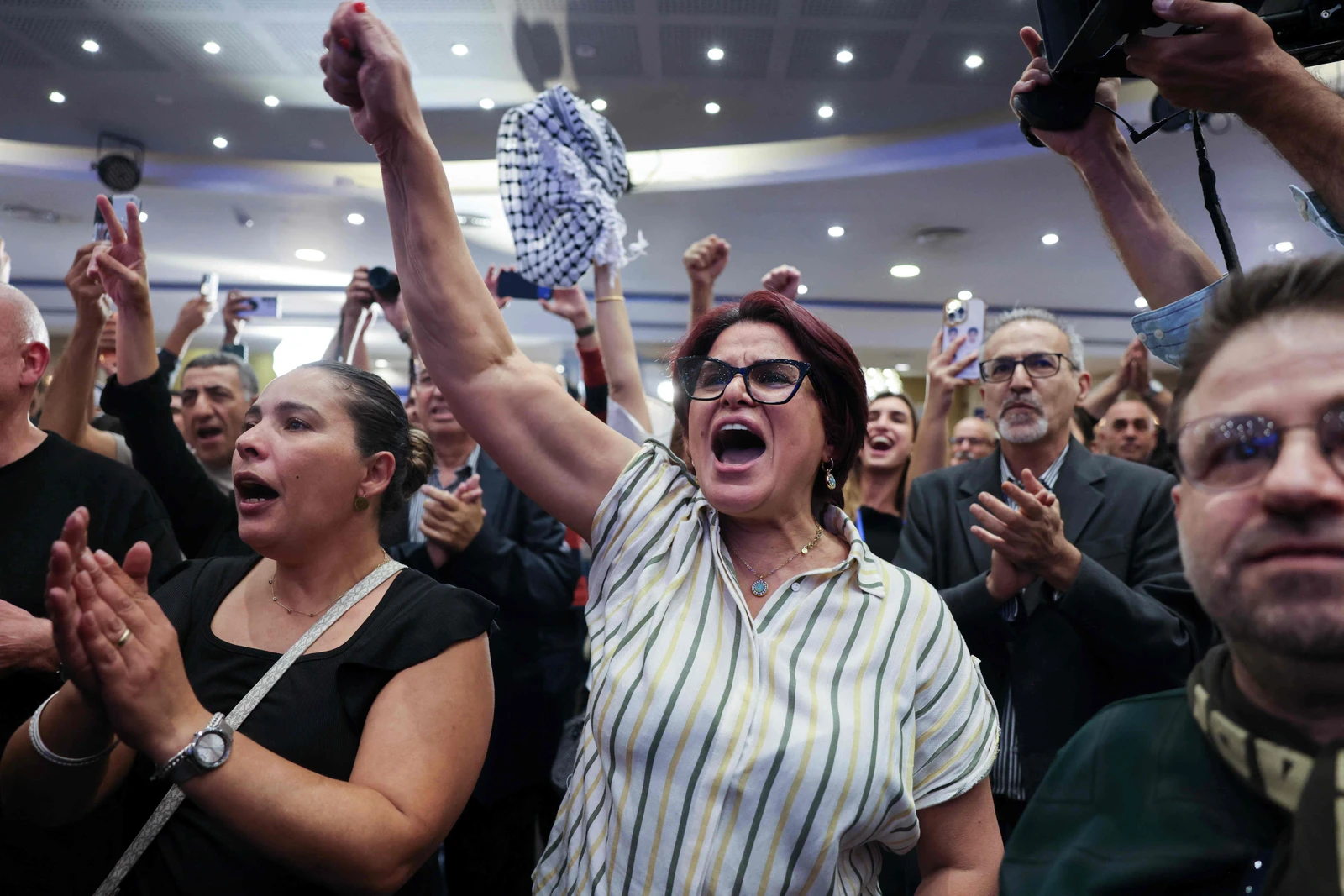
In the West Bank, flags and portraits of Abbas and Arafat, draped buildings in a Ramallah square where Palestinians watched a live broadcast of Abbas' speech. "This is something we should have done a long time ago," said Khaled Shtayyeh, 42, carrying a Palestinian flag. "I am very proud."
Trying to limit the fallout from the statehood bid, the Quartet of Middle East mediators agreed on a statement it hopes will revive Israeli-Palestinian peace talks, diplomats said.
Envoys of the Quartet — the European Union, Russia, the United Nations and the United States — were to meet Ban later, the diplomats said, declining to give details.
A gulf of mistrust separates Israelis and Palestinians, who each feel their existence is at stake in a bitter struggle over borders, security, refugees and Jerusalem.
Political rifts among Palestinians, and the constraints of US domestic politics, where support for Israel is strong, further complicate efforts to bridge the gaps.
The divisions are rooted in a heavy burden of history, painfully contested narratives and recurring bloodshed.