- TEL AVIV: US Defense Secretary Leon Panetta on Monday called for "bold action" from Israeli and Palestinian leaders to achieve peace after cautioning that Israel was becoming increasingly isolated in the Middle East.
Panetta, making his first trip to Israel since becoming Pentagon chief, met Defense Minister Ehud Barak at the start of his visit which included separate talks with Palestinian President Mahmoud Abbas and Israeli Prime Minister Benjamin Netanyahu.
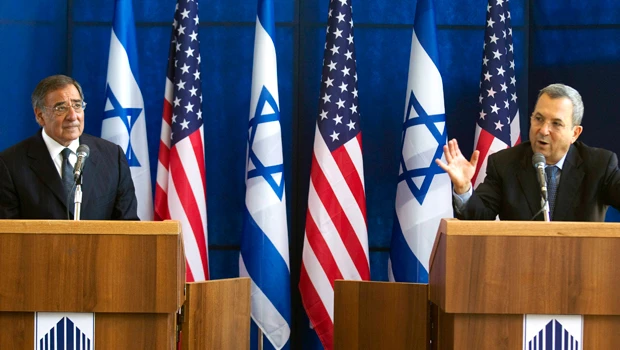
"I want to emphasize that there is a need, and an opportunity, for bold action on both sides to move toward a negotiated two-state solution. There is no alternative to negotiations," Panetta said at a news conference with Barak.
US-brokered peace talks collapsed a year ago after Netanyahu refused to extend a 10-month limited moratorium on construction in Jewish settlements in the West Bank.
Abbas has conditioned a return to negotiations on a settlement freeze and applied last month for full Palestinian membership of the United Nations, a move opposed by the United States and Israel which have urged him to resume talks.
A spokesman for Abbas said the Palestinian leader, in his meeting with Panetta, "stressed his readiness to go back to negotiations should Israel commit to stopping settlement activities and commit to the 1967 borders."
Speaking to reporters on his flight to Israel, Panetta said he would reaffirm US security commitments to Israel and try to help it improve its increasingly chilly relations with Turkey and Egypt.
"It's pretty clear, at this dramatic time in the Middle East when there have been so many changes, that it is not a good situation for Israel to become increasingly isolated. And that is what has happened," Panetta said.
Speaking at the news conference with Panetta, Barak said: "It is clear that in the world as a whole there are many who would like to see Israel cornered into a sort of isolation and it is clear to us that we have a responsibility to try to moderate, to ease tensions."
Panetta's Ramallah visit — hastily arranged after the UN move — marked the first time a senior US official has met Abbas since the Palestinian leader submitted the request to the United Nations on Sept. 23, which set off a flurry of US diplomacy designed to delay any UN action.
In the US Congress, pro-Israel lawmakers on two key committees have moved quickly to freeze $200 million in economic aid to the Palestinians in response to the campaign for UN recognition.
But Panetta criticized the move on Monday, saying: "This is a critical time. This is no time to withhold those funds."
Panetta's visit to the Middle East, which includes meetings with Egyptian leaders, comes at a time when Arab popular demand for political change has shaken the region, raising hopes, tensions and uncertainty.
Protests toppled governments in Tunisia and longtime US ally Egypt earlier this year and touched off a civil war in Libya that led to the ouster of leader Muammar Qaddafi.
But the changes have worried Israel and its staunchest ally the United States.
Egyptian protesters invaded the Israeli Embassy in Cairo a month ago in anger over a clash that killed five border guards. The military government's handling of that incident and comments afterward raised concerns in Israel about Cairo's future commitment to its long-standing peace deal with Tel Aviv.