
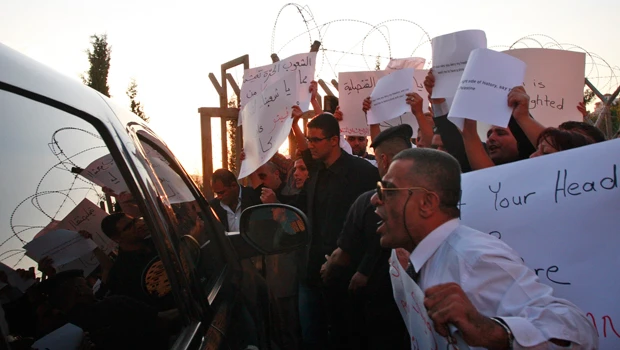
- RAMALLAH: Economic and humanitarian projects deemed vital for peace in the Middle East are threatened by a freeze on $200 million in aid by US Congress members opposed to a Palestinian bid for statehood at the United Nations, Palestinians and Western diplomats say.
They say the freeze, on money approved for the Palestinians this year, mixes politics with practical efforts to build peace with Israel and establish a Palestinian state.
The Palestinian Authority Cabinet, in a statement issued after its weekly meeting on Tuesday, “expressed hope that the US Congress would reconsider the freezing of aid allocated to the Palestinian National Authority.”
“Some parties in the Congress stood not only against the interests of the Palestinian people but also against any possibility of achieving growth for a people under occupation,” Economy Minister Hassan Abu Libda said.
“It was strange, and I expect the decision will be viewed negatively by Palestinian public opinion and it will influence the entire credibility of the United States,” he added.
“We are talking about $200 million divided among projects of the private sector, projects that have to do with the water sector, the infrastructure.”
Projects under way with USAID for the past three years include a five-year development of the health sector, training medical and administrative staffers, rehabilitating hospitals and equipping them.
Health Minister Fathi Abu Maghly said none of the health projects, worth a total of $87 million, was suspended as yet. In Jericho, work had been stopped on a municipality building.
US President Barack Obama is lobbying Congress to unblock the aid, although he has also warned the Palestinians that seeking statehood via a UN vote cannot be a substitute for a negotiated peace treaty with Israel.
Palestinians say Obama’s veto threat was a clear indication that Washington was not a genuine “honest broker” in diplomatic efforts to resolve the 63-year-old Middle East conflict.
“What this (US aid) money actually goes to are economic support projects, social projects and ... security,” said Quartet peace envoy Tony Blair, who is also trying to persuade Congress to let the aid flow as planned this year and next.
“I still hope at some point that it will be possible to persuade people that this isn’t really a good idea; that even if you’re completely opposed to the Palestinian bid in the United Nations, this is not the right way to respond to it because it’s harming Palestinian people and it’s harming the very things that over the past few years we’ve been most strongly supportive of.”
The International Monetary Fund and the World Bank say that financial problems threaten the state-building program overseen by Palestinian Prime Minister Salam Fayyad since 2009.
The 27-member European Union, the PA’s single biggest funder, has said that it will continue funding the Palestinian government.