
- So ingrained into the English lexicon is the word "jet" that it more readily brings to mind a means of aircraft propulsion rather than a squirt of liquid or air.
The adoption of the secondary and now the first thought of meaning has been a rapid process for the jet engine that was first built in 1937 at Brownsover Hall in Rugby, England.
Seven years earlier, in 1930, Frank Whittle who invented the device offered the idea to the British government. It was rejected as having insufficient value to be kept secret. Thence he patented it in the Public Patent’s Office in London, whence it very soon found its way abroad.
From those inauspicious beginnings this revolutionary propulsion system changed the transport, military and industrial worlds.
Traditionally of large size, they operate on the principle of sucking in air, compressing and igniting it then expelling it with tremendous force and incidentally, noise.
Fitting these things to cars was left as a mode of propulsion for eccentric drag-car racers and Batman until Rover produced Jet-1 about 60 years ago. Odd-looking beast it may have been but it completed the Le Mans 24-hour endurance race and at least proved car-borne jet power was possible if not practical. Jet-1 was a purely mechanical car. The gas turbine represented just another way of generating rotational motion, burning a fuel-air mixture of petrol, diesel or paraffin to spin a central shaft at up to 50,000rpm. Slow throttle response time and in a bulky body, the 243kmh Rover Gas Turbine Car was never going to be road practical — but the idea had been tested.
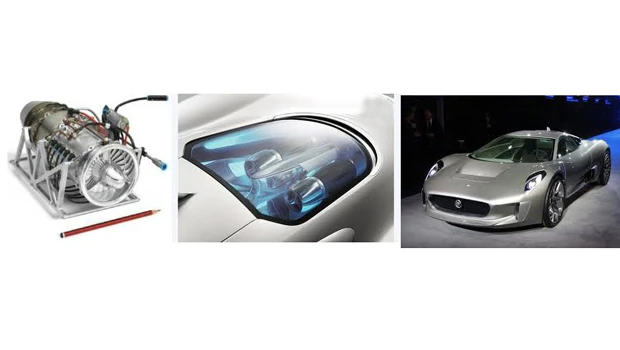
Half a century later, some chaps in machine sheds may, in their quiet British way, changed transport significantly by taking Whittle’s game-changing device one stage further and developing a true jet engine that will fit into a shoe box — literally. This miniaturization of the gas turbine has put its use for driving a road vehicle very much back on the agendum and is being taken extremely seriously. This time however, the turbine is not used to develop thrust (Batman) or its power to impart rotational motion to the mechanical drive mechanism (Rover) but to drive a generator that constantly charges a battery, which in turn powers electric motors.
And it is neither Batman nor a green drag-racer who is serious about it, but Jaguar.
Fully electric vehicles need to stop relatively frequently charge their batteries but a Range Extending Electric Vehicle (REEV), which generates its own power, does not. Jaguar has built one, the C-X75, it works and it is fast. It is the very essence of the early 21st century vehicle, the hybrid car.
Hybrids such as the Toyota Prius can run on rotational energy generated via electric motors or a small internal combustion engine, but REEVs always run under electric power, with the combustion engine running a generator to keep the battery topped up.
Fully electric vehicles are limited to the charge that a battery can hold, but a REEV generates its own power. It only has to carry enough batteries to drive it for a little more than the average distance of a journey, rather than having a much larger contingency capacity for rare longer trips. The result is less battery, less weight, less cost and better efficiency.
That efficiency is augmented by the fact that a REEV engine is only charging a battery and can always run at its most efficient speed. It does not have to cope with variable loads of acceleration (high) or cruising (low) because it does not drive the car directly.
Enter the chaps in sheds. People said micro-jets could not be built, but Paul and Chris Bladon came at the problem as machinists and their approach was slightly different.
Conventional wisdom said that miniaturization was impossible because the bladed disc (blisk) of the turbine had to be assembled in several parts, with the individually produced blades bonded to the central hub. The Bladons developed a process to machine blisks in a single piece from virtually any metal, including aerospace alloys of aluminum and nickel and even aerospace-grade titanium. The blades can be customized to any profile, sectional shape, edge radius and degree of taper from the root of the blade to the tip. From that the company has developed an axial-flow turbine weighing a little under 35kg, with a compressor only 75mm (less than a hand span) across.
The innovation that has made the C-X75 concept car possible — and which Jaguar Land Rover think could trigger a new generation of REEVs.
The Bladon turbine spins at a constant 80,000rpm and drives a generator capable of putting out 70kW. Moreover, the engines are not noisy. The turbine’s exhaust, which causes the racket from a big jet, is baffled and cooled by extra airflow.
Jaguar claims its four 145kW, 400Nm-torque hub-mounted electric motors will generate 780hp, pushing the C-X75 up to 328kph and from 0-100kph in 3.4 seconds. Then the big cat really gets it claws out and rips from 100 to 113 kph in a tooth-bending 1.1 seconds! A full charge in its lithium-ion batteries will provide power for 160 kilometers, but the two gas turbine engines extend this range to some 900 km.
As a bonus, the turbines run on virtually any fuel, from biofuels through diesel to jet fuel. Moreover with only one moving part, they will not gum up in the manner of a piston engine. Turbine technology is reliable, widely used in power generation and well understood.
Interest has been such that the company is reportedly embarking on a feasibility study to produce 1,000-2,000 cars per year, although it would be five to seven years before they could be commercially available.