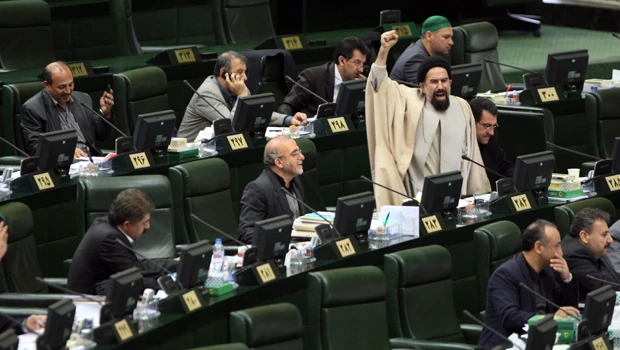
- TEHRAN: Iran’s parliament on Sunday approved a bill requiring both Iran and Britain to withdraw their respective ambassadors from each other’s countries, following London’s support of recently upgraded US sanctions on Tehran.
Iran’s relations with Britain have become increasingly strained over the past few months, largely driven by increasing tensions over Tehran’s nuclear program. The West claims that Iran is developing weapons but Tehran denies the claim.
During an open session broadcast live by state radio, 171 out of 196 lawmakers present voted for the bill requiring Iran to reduce its relationship with Britain to the level of charge d’affaires within two weeks.
Ismail Kowsari, a lawmaker and one of the sponsors of the bill, told the official IRNA news agency that the bill would lead to the removal of ambassadors.
The bill needs ratification by a constitutional watchdog to be a law. It also requires reduction of the volume of trade to a “minimum” level. It allows Iran’s foreign ministry to restore ambassador-level relations if the “hostile policy” of Britain changes.
Parliament’s decision is seen as a reaction to London’s support of a new US package of sanctions in Iran. London banned all British financial institutions from doing business with their Iranian counterparts, including the Central Bank of Iran.
The measures were coordinated with Britain and Canada and build on previous sanctions to target Iran’s oil and petrochemical industries and companies involved in nuclear procurement or enrichment activity.
By announcing its moves ahead of other European Union countries, Britain — which Iranians often refer to as “the old fox” — is first in the firing line for retaliation by Tehran, but lawmakers said they would push to cut ties with other EU countries if, as expected, they follow London’s lead.
“The legislative branch is observing the behavior of the British government and this is just the beginning of the road,” speaker Ali Larijani told parliament.
Lawmakers who spoke out against the bill did so because they deemed it not strong enough.
“This plan should be firmer and stronger against Britain,” Mahmoud Ahmadi Bighash told the house. “Having relations with Britain, even with one representative, is a total betrayal and we should padlock the British embassy.”
Another member went even further, invoking the storming of the US embassy — dubbed the “den of spies” — by students in the 1979 Islamic revolution. The hostage crisis lasted for 444 days and set the tone for rock-bottom relations between Tehran and Washington ever since.
“The British government should know that if they insist on their evil stances the Iranian people will punch them in the mouth, exactly as happened against America’s den of spies, before it was approved by officials,” Mehdi Kuchakzadeh said.
Ahead of the vote, lawmakers chanted “Death to England.”
Britain is resented by many Iranians for its exploitation of its oil in the early 20th century and its involvement with the United States in a 1953 coup which ousted Prime Minister Mohammed Mossadeq who had nationalized the oil industry.
The annual volume of trade between Iran and Britain is about $500 million.
Iranian oil exports are a large component of this trade. In the first half of 2011, Iran sold some 11,000 barrels of crude to Britain per day, some 0.5 percent of Iran’s daily production.
British Midland International airline carries some 80, 000 between Tehran and London per year in its daily flight. Some 100,000 Iranians live in Britain.
Parliament’s website said there would be a demonstration outside the British embassy on Tuesday, the first anniversary of the death of Majid Shahriyari, a nuclear scientist killed along with his wife by a car bomb that Tehran said was the work of Israeli agents.
London and Washington announced new sanctions after a UN nuclear agency report suggested Iran had worked on an atomic bomb design. Tehran maintains its work is entirely peaceful and said the report was based on false Western intelligence.
The tension between the two countries is not limited to the nuclear dispute.
The hard-liners that run the Islamic Republic accuse Britain and other western countries of colluding with anti-government protesters after the contested re-election of President Mahmoud Ahmadinejad in 2009.
Earlier in October, the mayor of Tehran ordered a lawsuit to be filed contesting the ownership of the land on which Britain’s embassy has stood since 19th century.
In September, Iran detained and summoned a group of people for their alleged links to BBC’s Farsi-language service.
Since the turmoil which followed Iran’s 2009 elections, Tehran has repeatedly accused Britain of fomenting unrest. London denies the charge.
In the meantime, EU foreign ministers are due to meet on Thursday to approve new sanctions on Iran.
Paris has proposed banning oil imports to the bloc, which accounted for 18 percent of Iranian oil purchases in the first half of 2011, and the Netherlands is pushing for the EU to follow London’s move on sanctioning the Iranian central bank.
Parliament’s bill instructs the foreign ministry to downgrade relations with any country that follows London’s sanctions move.