- CAIRO: Egypt's military rulers, protesters and future political leaders were locked in a fierce power struggle on Sunday that set the country on edge ahead of the first elections since its revolution.
Egyptians go to the polls on Monday to cast their votes for a new Parliament after the end of the 30-year rule of strongman Hosni Mubarak, forced from power last February in one of the seminal moments of the Arab Spring. The run-up to voting in the cultural heart of the Arab world and region's most populous country has been marred by violence and fears of chaos as the army, protesters and new political figures jostle for influence.
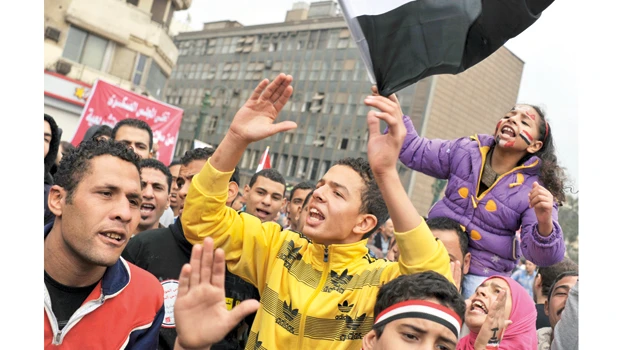
Protesters rallied again in Cairo's Tahrir Square on Sunday to try to evict the generals who replaced Mubarak. The election that gets under way on Monday and Tuesday is the first step on the ruling military council's timetable toward a transfer to civilian rule, now promised for July.
Some Egyptians yearn for stability after a week of bloodshed that has killed 42 people and wounded over 2,000, preferring for now to let the generals run the nation. But the demonstrators want the council to make way for a civilian interim administration immediately. They reject its choice of 78-year-old Kamal Al-Ganzouri to form the next Cabinet.
Field Marshal Mohamed Hussein Tantawi, head of the council, said the army would ensure security at the polling booths. "We are at a crossroads. There are only two routes, the success of elections leading Egypt toward safety or facing dangerous hurdles that we in the armed forces, as part of the Egyptian people, will not allow," he declared.
Abdel Moneim Aboul Futuh, an Islamist presidential candidate who opposes military rule, said: "The nation is larger than Field Marshal Tantawi and Lt. Gen. Sami Enan and the military council. A government with revolutionary leadership must be formed to meet the demands of Tahrir Square."
State television quoted Tantawi as saying the army's role in the new constitution would be unchanged: to protect the nation. The outgoing Cabinet angered many Egyptians by floating proposals that would have given the army sweeping national security powers and protected it from civilian scrutiny.
In an effort to resolve the crisis, Tantawi called a meeting with all political party leaders and future presidential candidates, but it was boycotted by several leading figures.
Tantawi warned Sunday that no one would be allowed to pressure the armed forces and asked senior political leaders Mohamed ElBaradei, former head of the UN nuclear watchdog, and ex-Arab League chief Amr Moussa for support.
"We are faced with enormous challenges and we will not allow any individual or party to pressure the armed forces," he told reporters, asking that ElBaradei and Moussa "support the government of Al-Ganzouri."
Tantawi said the military will follow through with its somewhat vague road map for handing over power. The ruling council never set a precise date for transferring authority to an elected civilian administration, only pledging that presidential elections — the last step in the handover process — will be held before the end of June, 2012.