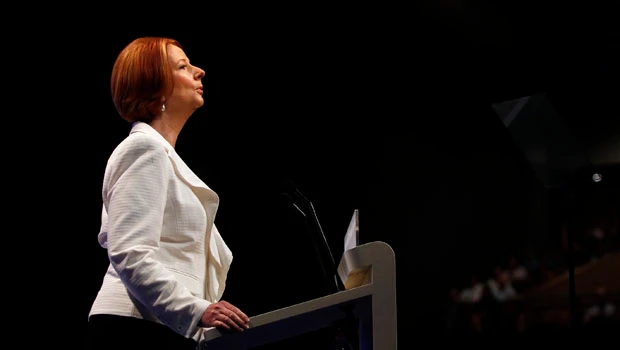
- SYDNEY: Australian Prime Minister Julia Gillard gave her Labour Party cautious hope of a political revival on Sunday by stamping her authority over policy direction at the party’s national conference and ending the year with a series of political wins.
At her first party conference as leader, Gillard won a series of divisive debates on her plans to sell uranium to India, process asylum seekers offshore and to prevent laws for same sex marriage.
But opinion polls show Gillard’s minority government remains highly unpopular and would be easily swept from office, leaving Labour Party members now hoping she can build on the momentum of the past two months to restore the party’s hopes for elections due in late 2013.
“I’m hoping for a revival. But living in hope is about all we’ve got,” long-term Labor supporter Bob Laughton, who joined the party in 1946 and has attended party conferences ever since, told Reuters on Sunday.
Gillard, who ousted former leader Kevin Rudd in a party coup in mid 2010, formed a minority government with a one-seat majority after last year’s dead-heat elections, but needs the Greens and three independents for her slender majority.
That ensured 2011 was a tumultuous year as Gillard had to negotiate every policy proposal through parliament, often making compromises that upset her own party or one or more her minority-government allies.
But Gillard ended the year on a high after she secured parliament’s backing for a landmark carbon tax, and a 30 percent tax on iron ore and coal mines, and after hosting successful visits by Queen Elizabeth and US President Barack Obama.
Gillard then pulled off a political coup by luring a disgruntled opposition lawmaker to defect and take the job of speaker, in a move that deeply embarrassed opposition leader Tony Abbott and strengthened her majority to three.
Despite Gillard’s strong end to the year, significant problems remain as she attempts to rebuild voter support, including uncertainty over the global economy and unpopular gambling reforms due to dominate in 2012.
Long-term Labour Party backer, historian and author Bob Ellis said the national conference, which is held once every three years, provided an important platform for Gillard’s revival but it was too early to claim a permanent rebound.
“The momentum this conference is adding, plus the loss of confidence in Abbott’s Liberals, is significant but not decisive,” Ellis told Reuters on Sunday.
He said Gillard remained unpopular and could be dragging down Labor’s vote by around five percent across the nation.
In contrast, Laughton is a strong supporter of Gillard, but is also worried that the party has lost its way and that Gillard is being pushed and pulled by backroom factional leaders.
The 78-year-old Korean War veteran said Gillard had struggled to focus on traditional Labour Party values such as jobs, education, and fighting poverty and homelessness.
“If we can’t sell issues like those, we can’t sell anything,” Laughton said.
Gillard deliberately avoided any talk of a resurgence at the conference, and instead focused on allowing her party to have genuine policy debates rather than the stage-managed arguments of the past 20 years and under Rudd’s leadership.
Her opponent, Abbott, however, spent the day campaigning against the government’s planned gambling reforms, and he labelled the Labour Party conference as an exercise in navel-gazing, orchestrated by factional leaders.
“They’re desperately trying to prop up Julia Gillard, at the same time to airbrush Kevin Rudd out of the Labour Party’s history,” he told reporters.