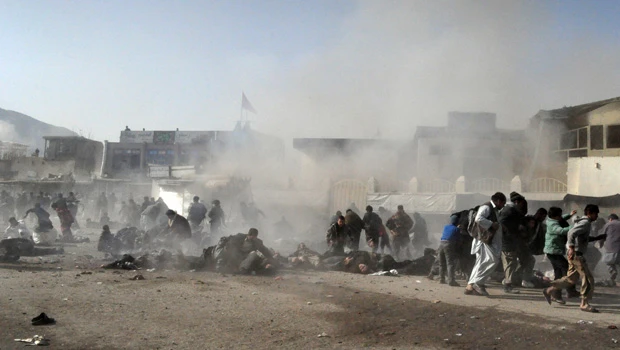
- KABUL: A suicide bomber struck a crowd of worshippers at a mosque in Kabul on Tuesday, killing at least 55 people in the deadliest of two attacks on a holy day — the first major sectarian assaults since the fall of the Taleban a decade ago.
Four other worshippers were killed in the northern city of Mazar-i-Sharif when a bomb strapped to a bicycle exploded as a convoy of Afghan worshippers was driving down the road, shouting slogans for the festival known as Ashoura. Health Ministry spokesman Sakhi Kargar gave the death toll and said 21 people also were wounded in that attack.
The Kabul bomber blew himself up in the midst of a crowd of men, women and children gathered outside the Abul Fazl shrine to commemorate the seventh century death of the Prophet Muhammad’s grandson Imam Hussein. Some men were beating themselves in mourning and food was being distributed.
The shrine, which is near the presidential palace, was packed with worshippers and dozens more were crammed into the courtyard. One witness said the bomber was at the end of a line and detonated his explosives near one of the gates to the shrine.
Bodies of the dead lay on top of one another where they fell to their deaths. Survivors with blood-smeared faces cried amid the chaos.
The Ministry of Interior said 55 were killed — including two women and four children. Sayed Kabir Amiri, who is in charge of Kabul hospitals said more than 160 wounded in the blast.
That made it the single deadliest attack in the Afghan capital in more than three years. A suicide car bomber detonated his explosives at the gates of the Indian Embassy in Kabul on July 7, 2008, killing more than 60 people.
No group claimed responsibility for Tuesday’s blasts, reminiscent of the wave of sectarian attacks that shook Iraq during the height of the war there.
The Ministry of Interior in a statement blamed the Taleban and “terrorists,” for the attack. It provided no other details but added that police defused another bomb that had been planted in Mazar-i-Sharif near the one that blew up.
The Taleban strongly condemned the two attacks and said in a statement to news organizations that they deeply regretted that innocent Afghans were killed and wounded.
Afghan President Hamid Karzai, speaking at a news conference after meeting German Chancellor Angela Merkel in Berlin, said the attack was unprecedented in scope and the first time ever that one has been carried out during a religious event.
He said it was “the first time that on such an important religious day in Afghanistan terrorism of that horrible nature is taking place.”
Mohammad Bakir Shaikzada, the top Shiite cleric in Kabul, said he could not remember a similar attack having taken place on such a scale.
“This is a crime against Muslims during the holy day of Ashoura. We Muslims will never forget these attacks. It is the enemy of the Muslims who are carrying them out,” he said, declining to place blame.
It was unclear whether Tuesday’s attacks mark a change in Afghan Taleban strategy or were carried out by Al-Qaeda or another group based in Pakistan.
Mahood Khan, who is in charge of the Abul Fazl shrine, said the explosion occurred just outside a courtyard where dozens of worshippers were lined up as they filed in and out of the packed building.
A few minutes after the blast, bodies could be seen loaded into the trunks of cars while wounded were led away by friends and relatives. Survivors wept in the streets.
“It was a very powerful blast,” Khan said. “The food was everywhere. It was out of control. Everyone was crying, shouting. It is a disaster.”
Mustafa, a shopkeeper, said he and his mother were delivering food to the worshippers when the blast occurred. Two groups of 150 to 200 people from Kabul had just prayed at the shrine and left.
Another group of more than 100 from Logar province was entering when the explosion occurred. He said the suicide bomber was at the end of the line of worshippers from Logar when he blew himself up near one of the gates to the shrine.
“It was very loud. My ears went deaf and I was blown 3 meters (yards),” said Mustafa, who uses only one name. “There was smoke and red blood on the floor of the shrine. There were people lying everywhere.”
The shrine’s loudspeaker continued to blast a recitation of the Qur’an as ambulances carried bodies and wounded away. Women stood outside the shrine wailing and holding crying children.
The shrine is close to the palace where Karzai lives and who is in Europe to attend an international conference on Afghanistan. It is named after Abul Fazl, who was an adviser to a 14th century Mogul emperor. The shrine with its blue minaret is one of Kabul’s better known shrines. It is located in Murad Khane area near the Kabul river, a district that has been listed by the World Monuments Fund as one of its 100 most endangered sites of cultural heritage.