
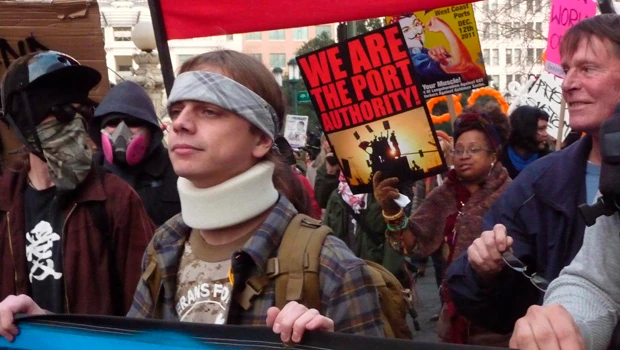
- OAKLAND, California: Anti-Wall Street activists trying to shut down West Coast ports on Monday managed to close several terminals and at times clashed with police but fell short of mounting the full-scale cargo blockade they had promised.
Thousands of demonstrators marched on ports from Southern California to Alaska, hoping to call attention to US economic inequalities, high unemployment and a financial system they say is unfairly skewed toward the wealthy.
They succeeded in disrupting arrivals of trucks and dockworkers at some waterfronts, effectively closing three terminals in Portland, Oregon, and another in Seattle.
At the Port of Long Beach, adjacent to Los Angeles, some 250 to 300 people rallied in the rain at a terminal facility where they scuffled with helmeted police officers who shoved them back with batons in an effort to keep the entryway clear.
Two were arrested before demonstrators left the area to block traffic along a thoroughfare through the port. But protesters later began to disperse on their own as rains grew heavier and police converged in force.
As darkness fell in Seattle, officers set off flash grenades before making several arrests near Terminal 18, police said on Twitter.
In nearby Bellingham, Washington, authorities arrested about 16 people who had sprawled across Burlington Northern Santa Fe tracks in an attempt to stop trains from reaching the port there, railway spokesman Gus Melonas said.
But by dark demonstrators had largely failed to cause the large-scale immobilization of commerce they had sought.
The long-planned action comes after the Occupy Wall Street movement that began in New York in September has seen its tent camps in most big West Coast cities dismantled in police raids, leaving the movement looking to regain its footing.
The largest action unfolded in Oakland, long an Occupy hotspot where protesters hoped to stage a repeat of an October protest that briefly succeeded in shuttering the port, the nation’s fifth busiest container port by volume.
“Whose ports? Our ports!” a crowd of around 1,000 activists chanted as they paraded before dawn from a transit station to the city’s cargo port and split into groups to try to block terminal entrances.
Tractor-trailers were prevented from entering at least two terminals where protesters formed picket lines in front of police. Police reported two arrests, but port authorities and protest organizers gave conflicting accounts of the outcome.
Former Marine Scott Olsen, whose injury during clashes between Oakland police and demonstrators in October gave fresh impetus to protests, later led an afternoon march in Oakland.
Occupy Oakland spokesman Mike King called the blockade a success, saying cargo traffic at the port was limited to just two vessels in anticipation of the demonstration, and that longshoremen and Teamsters were largely absent from work.
“Nobody crossed the picket line, and most truckers stayed away,” King said, adding that the only cargo loaded onto trucks in the terminal yards was material already taken off ships.
The port’s executive director, Omar Benjamin, acknowledged “sporadic disruptions” but insisted the facility had remained operational throughout the day.
Benjamin had no details about the extent of disruptions, and could not say whether any ships were unloaded or whether union workers had reported to their jobs.
Workers affected by the protests were divided.
“It’s not good for the economy,” said Agustin Luna, 39, an independent trucker waiting in his big rig to deliver a load of alfalfa to a ship in Oakland bound for Japan.
But Sean Martin, another independent trucker waiting outside an Oakland terminal, said: “I support what they are trying to do. Wages have steadily dropped.”
In San Diego, four people were arrested at that city’s port as demonstrators tried to block a road into the facility.
In Oregon, several hundred protesters at Portland’s harbor blocked gates to two of the port’s four main terminals, including the chief deep-draft container dock, forcing the closure of both facilities.
“We are not able to get trucks through or employees in,” port spokesman Josh Thomas said. “Nobody is going to work, not the longshoremen, office workers or truckers.”
Portland police said they had detained three men in a car on their way to the port several hours before the march during a traffic stop in which officers seized a loaded .40-caliber handgun, a sword, radios and gas masks.
The men told police they had planned to attend the demonstration and had arrived early to “scout the area.” The driver was arrested on a charge of possessing a loaded firearm in public while a passenger was held on an outstanding warrant. The third man was released.
Protests at the Port of Longview in Washington state prompted officials there to send 16 longshoremen home after their terminal was deemed “an unsafe work environment,” said Dan Coffman, president of the International Longshore and Warehouse Union Local 21.
The two largest labor unions caught up in the protests were split, with the longshoremen’s union opposed to the attempted blockade and the Teamsters taking a neutral stance.
The protests were focused in part on truck drivers who earn low wages and cannot join unions because they are classified as independent and must provide their own trucks.
In a show of solidarity with the West Coast protests, some protesters refused to leave a private atrium in the World Financial Center in New York City, and 17 were arrested.