- JAKARTA: An Indonesian minister has called upon Muslim countries to redefine their architecture into an open, effective, inclusive and transparent one in order to play a vital role in the modern and fast developing world.
“We must become more people-centered and recognize that greater and faster information flows will mean transparency, which is no longer a choice, but a must,” said Tifatul Sembiring, minister of communications and information technology.
Addressing the first session of an international Muslim media conference here on Tuesday, he said: “We have to be more clever and intelligent to utilize the media to broadcast our message to the world through more friendly content.” The minister also advised Muslims to be more pragmatic and realistic in their approach.
“We must now promote the Muslim countries’ architecture in which geoeconomics of cooperation is prevalent in contrast with the geopolitics of the past. This geoeconomics should drive nations to work together as mutual stake holders, on the basis of common interests, driven by new opportunities,” he said.
The conference, organized by the Makkah-based Muslim World League in cooperation with the Indonesian Ministry of Religious Affairs, is attended by nearly 500 journalists and academics from different parts of the Islamic world. Sembiring also spoke about new power centers that are growing rapidly with power relationships changing and becoming much more fluid. “We must make sure that these relationships lead to growing confidence, greater cooperation and even closer integration. One way to ensure such a healthy dynamic equilibrium is to transform relationships into partnerships,” he added. Speaking about unfriendly attitude of some Western countries toward Islam and Muslims, he said: “Though media we should convince those countries and their people that Islam is a blessing for the whole mankind and not a menace.” Sembiring, who referred to the dramatic progress he brought about in Indonesia’s communication sector, emphasized the need to make use of modern communications means to boost social and economic development. “We are living in the age of connectivity, the age of information and openness.
Traditional hierarchies are being matched by new networks of individuals and organizations in a borderless world. Every individual with the right digital tools can become his own voice in the market place of ideas,” he pointed out. He also urged Muslim governments to accommodate and embrace the revolutionary change in the social landscape of their countries. In order to progress together, he continued: “We need to adopt a win-win mindset and oppose the zero-sum win-lose approach that was predominant in the last century.” He said the Muslim countries, which connect Africa, Middle East, part of Europe, Central Asia and Fareast Asia, and covers both the Pacific and Indian oceans, is fast emerging to be the strategic and economic pivot of the world.
“If we can identify the way forward, what we do to ensure peace and progress in the region, we will also define the future of the world,” he said. Sembiring said Muslim countries should work together with a good planning to leave an impact in the world.
“We can make progress if we work hard. Success will not come without any effort. We must build it brick by brick by utilizing among other things the media,” he said.
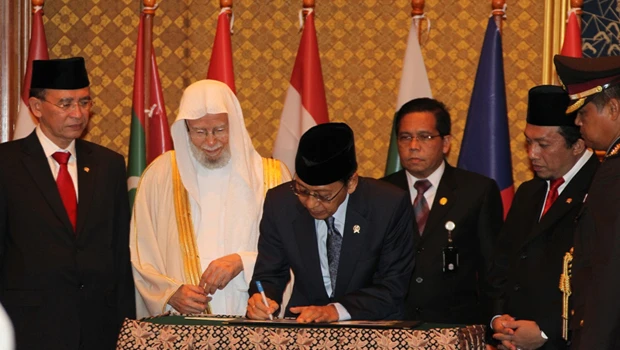
The three-day conference was opened by Indonesian Vice President Boediono on Monday and the opening session was attended by MWL Secretary-General Dr.
Abdullah Al-Turki, Deputy Culture and Information Minister Dr. Abdullah Al-Jasser and Indonesian Religious Affairs Minister Suryadharma Ali.
Dr. Saud Saleh Katib of King Abdulaziz University in Jeddah was one of the keynote speakers on Tuesday. He presented a paper on “New Media and Social Issues: Challenges and Opportunities” and highlighting the leading role of social media in making social and political changes. He urged governments and companies to respond quickly to people’s legitimate and genuine demands to avoid public wrath and action.
Prof. Alwi Dahlan of the University of Indonesia presented a paper on “Characteristics and Trends of the New Media” while Prof. Azmuddin Ibrahim of Malaysia spoke on the “Impact of Modern Media and the Phenomena of Violence and Moral Decadence.” Dr. Andi Faisal Bakti of the State Islamic University in Jakarta gave a presentation on “Islamic Media: Between Religious Principles and Globalization.”