
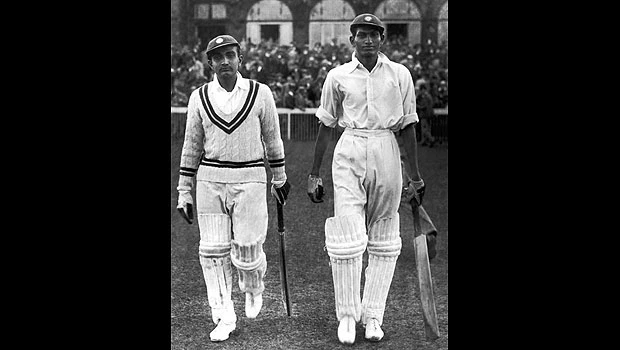
- Mushtaq Ali made cricketing history by becoming the first Indian ever to score a Test century on foreign soil.
- Australian all rounder Keith Miller described him as the “Errol Flynn of cricket, dashing, flamboyant, swashbuckling and immensely popular.”
Born on Dec. 17, 1914, in Indore, Madhya Pradesh, India, Mushtaq, the son of a police officer, studied in Indore and then at Aligarh Muslim University. Mushtaq, the exhilarating Indore opener described his entry into the cricketing world to Boria Majumdar succintly: “At 15, I had accompanied Col. Nayudu to Hyderabad. Not only did we travel first class, we were driven to our destination in a Rolls Royce once we landed at the station. Playing for the Maharaj of Dhanrajgir's team, we were soon flooded with gifts and having played decently I saw my name flashed in all India dailies the next day.” He then went on to make his Test debut at the age of 19 in Calcutta, starting as a slow left-arm bowler.
Mushtaq — tall, handsome and a devout Muslim who played his best to the delight of all — once remarked that spectators spend money on tickets, sit in the sun, go home and narrate what they saw hence he considered it his duty to make them happy. No wonder he was regarded as the darling of the spectators.
In 1936 on the second day of the India-England Test at Old Trafford when India was trailing by 368 runs, Mushtaq played magnificently. When he was at 96, Wally Hammond from the English team went to him and said, “My boy, be steady, get your hundred first.” Mushtaq went on to achieve his century by the end of the day and was gifted a gold wristwatch by the captain of the Indian team Vizzy (the Maharajkumar of Vizianagram).
Boria Muzumdar described Mushtaq and his feat as “The first Indian centurion overseas. Needless to say that 100 runs in 1936 was extremely significant since it proved to the British that the Indians could match the colonizers at their game and was perceived as a major national triumph in contemporary India.”
Sankhya Krishnan writes that Mushtaq lighted up every ground with his incandescence and was the original dasher and the biggest draw of his day. He drove and pulled with lightening reflexes taking 15 runs off one over by Allen. He stepped down the track to upset the rhythm of the quick bowlers, playing like a daredevil to the crowd’s delight.
Wisden cricket wrote, “Mushtaq Ali was a maverick strokeplayer with a love of sudden forays down the pitch, even to quick bowlers, and daring strokes that had bowlers tearing their hair out.”Sir Neville Cardus wrote, "There was a suppleness and a loose, easy grace which concealed power, as the feline silkiness conceals the strength of some jungle beauty of gleaming eyes and sharp fangs."
While writers waxed eloquent about Mushtaq’s performances, Indian cricketer Polly Umrigar called Mushtaq a thorough gentleman and said Australian fast bowler Sam Loxton thought that Mushtaq “must be the best opener in the world” for batting so consistently. According to S. Thyagarajan, “Mushtaq fans remember even today his one hand stroke to steer India to a three-wicket win against the first Commonwealth team at Chepauk in 1931.” In 1948-49 in the third Test against the West Indies he scored 54 and 106 at Eden Gardens in Calcutta.
In domestic cricket, in 1944-45 playing for the Holkars he scored a century in each innings (109 and 130) against Bombay. In 1950-51 he made a hat trick of centuries scoring 948 runs against Hyderabad, West Bengal and U.P. and smashing 187 against Gujarat. Zulfiqar Ali Bhutto was a great fan of Mushtaq. In 1972 he had informed the late Khalid Hasan, who had worked for him, to invite Mushtaq to Pakistan. Khalid wrote in an article that one of his regrets is not having followed up on Bhutto’s desire due to the political situation at the time.
In spite of his great performance on the field, due to petty politics he was not a favorite of some selectors. When the Australian services team arrived in India he was not selected for the India XI team. During the second Test at Calcutta (Now Kolkata) the spectators were very upset at the Indian team not selecting Mushtaq. They entered the pavilion shouting and holding placards “No Mushtaq, No Match.” Some even grabbed Duleepsinhji (the then chairman of the selection committee) by his tie and tried to manhandle him. Mushtaq, the gentleman that he was, intervened quickly when he saw the roughing up of the chairman by the crowd and saved Duleepsinhji. The selectors were forced to call him back to the team. Overall, Mushtaq was only selected for 11 Tests in which he scored 612 runs. Haresh Pandya writes “A batsman of his ability and productivity deserved more Tests.”
In India in those days teams and gymkhanas were also named according to religions and the Pentangular Tournament in Bombay (now Mumbai), which was very popular at the time, hosted teams such as the Muslims, Hindus, Parsees, Europeans and the Rest. Mushtaq was the captain of the Muslims while Vijay Merchant skippered the Hindus. During the 1944-45 Pentangular tournament these two teams reached the final that took place at the packed Brabourne Stadium. A final between the Muslims and Hindus further added to the energy and excitement of the jam-packed Bombay crowd. Cricket veteran Hardstaff said “I don’t remember seeing a more thrilling match in my life.”
On an earlier ball Mushtaq was severely injured. Some were unsure if he would continue to play, then one of the best moments in Mushtaq’s life was when he was encouraged by his mentor C. K. Nayudu to go on and play, and he played the innings of his life. Mushtaq went on to add a crucial 36 and the Muslims won the match and tournament. The captain of the Hindus, Vijay Merchant went to congratulate Mushtaq after the match. He warmly hugged Mushtaq and said, “Well played Muslims, you deserved to win.”
Even though in 1964 the Indian government awarded Mushtaq the Padma Shri award, he was never given any work or position (such as a coach, manager or selector in the cricket administration) after his retirement. The MCC made him an Honorary Life member. In 2002, Wisden also honored him with a special award.
Mushtaq promptly replied to letters from friends and fans. In a letter to the late Meraj Siddique from Washington, he ends the letter with a line from an Urdu film song “Jab yaad mere aaye milne ki dua karna” (When you remember me, pray that we meet). In 1967 he wrote his autobiography entitled ‘Cricket Delightful’.
Mushtaq died in his sleep on June 18, 2005, in Indore at the age of 90. He left behind a wife, two sons and two daughters. Thyagarajan wrote on Mushtaq’s passing, “A giant has gone…the moment marked the end of an epoch in Indian cricket. Mushtaq symbolized the romance of batmanship, the essence of aggression laced with indescribable charm and elegance.”
The late Khalid Hasan wrote “Cricketers come and go but there are some who leave their imprint on the game and who are remembered long after they have departed the scene, Mushtaq Ali was one such.”