
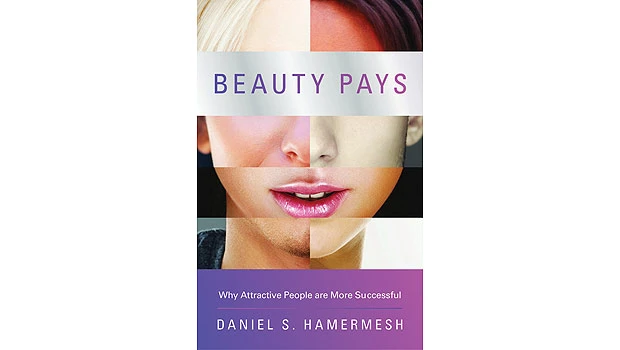
- Daniel Hamermesh is the founder of the economics of beauty.
- His recent publication, “Beauty Pays,” crowns 20 years of research to find the connection between physical appearance and wages.
“I thought it would be fun to think about how beauty affects earnings and labor markets generally. The result was the first of the six refereed scholarly papers that I have published on this topic,” writes the author who acknowledges that many of his peers found this topic beyond the scope of economic research.
People’s response to beauty is practically the same around the world. The author mentions a telling anecdote concerning the Chinese producers of the 2008 Summer Olympics who chose a beautiful nine-year-old to lip-sync a plain looking child with a better voice. And who has forgotten the memorable appearance of Suzan Boyle as a contestant on the reality show “Britain’s Got Talent” in 2009? Despite her plain looks and stout figure, she attracted international attention with her stunning voice.
From the dawn of time, people have indulged in personal beautification. Traces of body paints have been discovered in Paleolithic sites and man’s concern for his physical appearance has never abated. In fact, it is quite the opposite. Nowadays, we are more than ever obsessed with beauty.
However, do we agree on what makes a person beautiful? A leading work by Judith Langlois has concluded that an agreement on what constitutes human beauty, and especially human ugliness, is formed very early in life and that symmetry is beauty. Therefore, a symmetric face is considered beautiful.
The idea of becoming more attractive is increasingly appealing to people. In the year 2007, Americans received over 4.6 million injections of Botox, had 285,000 nose-reshaping surgeries and 241,000 eyelid surgeries. People strongly believe that clothes, hairstyle, cosmetics and surgery will improve their economic outlook. However, studies have shown these beliefs to be wrong.
“In the Chinese study, each dollar spent on improving beauty brought back only four cents on average. Just as much of our spending on health may not increase our longevity, but may let us enjoy life more, so too it may make sense to spend on plastic surgery and better clothes. The best reason for this kind of spending is that it makes you happier. It is not a good investment if you seek only the narrow goal of economic improvement,” says Hamermesh.
However, the issue of measuring the effects of looks on earnings has been thoroughly researched. The results, clearly showing that worse-looking workers earn less than their good-looking peers, seem to be a characteristic of individualized countries. There are still too few studies of the impact of beauty in poor countries to imply that the same happens in less developed countries.
Looking good is required in an increasing number of jobs and especially in the world of politics. Candidates nowadays must appear on television and look their best. However, according to Hamermesh: “Bad looks are less of an electoral impediment when voters have gained confidence in a politician.”
But what about good-looking employees? Can they raise sales? A number of studies have shown that hiring better-looking people does increase a company’s sales. Furthermore, the extra costs resulting from paying more for better-looking workers are partly covered by the greater sales that those workers can generate for it. According to the author, employers do explicitly seem to believe that they will raise their sales by hiring better-looking workers:
“In countries where, unlike in the United States, help-wanted advertisements can specify personal characteristics, including beauty, we see employers specifically mentioning beauty in seeking applicants.”
This can be seen in China where a recent study showed that advertisements included a requirement for looks nearly 10 percent of the time, with a much greater prevalence in lower-skilled jobs.
Hamermesh also believes that companies where executives’ looks differed, reached higher sales. What matters most is to set up a team of executives with a beneficial mix of looks and ensuring that they specialize in tasks that take advantage of differences in their looks.
Although our modern society is biased against ugliness, with improved technologies, people can improve their looks, and we will end up by paying less attention to less obvious physical differences. It is also interesting to mention that a study showed that when people get richer, the criteria about human beauty seem to change.
In the end, one should remember “that although differences in beauty have large impacts, they account for only small parts of the differences in outcomes that people experience at work.”
Moreover, the most effective determinant of earnings remains education. In the U.S., for example, each extra year of schooling raises the earnings of otherwise identical workers by around 10 percent.
“Looks are fate; but so are many other things. But bad looks are not a crucial disadvantage, not something that our own actions cannot at least partly overcome, and not something whose burden should so overwhelming as to crush our spirit,” concludes Hamermesh.
The title, “Beauty Pays,” reflects a reality that nobody can ignore. Unfortunately, the author, like his peers whose “narrow-mindedness” he says, “has conspired in the past to make economics boring in the eyes of many non-economists,” was not able to avoid the same pitfalls. What might have been an entertaining read has turned into a tedious and seemingly endless listing of academic researches and mind-numbing statistics. Hamermesh, professor of labor economics at Maastricht University, has written exclusively for members of his profession and students of the economics of beauty. He has sadly failed to show us, the uninitiated reader, the beauty of economics.