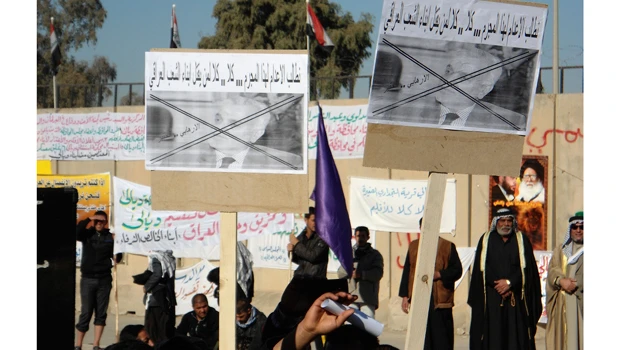
- BAGHDAD: The Iraqi vice president accused of running death squads hit back at the prime minister on Tuesday in a sectarian feud that risks wrecking Iraq’s fragile balance of power, just days after US troops finally withdrew.
In dismissing the charges against him as fabricated and part of machinations by premier Nuri Al-Maliki, Vice President Tareq Al-Hashemi evoked wider regional tensions by appealing to the Arab League and denouncing “foreign agendas” in Iraq.
As Hashemi declared his willingness to face judges in Iraq’s autonomous Kurdish region — where he traveled after an arrest warrant was issued for him in Baghdad — one of his allies was lambasting Maliki for acting like Saddam Hussein and risking renewed sectarian strife.
Holding a news conference in the Iraqi Kurdish capital Arbil a day after supposed bodyguards to Hashemi confessed on television to a campaign of shootings and bombings, the vice president said: “I swear, Hashemi did not commit any sin against Iraqi blood and will not commit any, either today or tomorrow.”
“The whole issue is Maliki’s fault,” he added.
“I am demanding the case be transferred to Kurdistan ... and that representatives of the Arab League or Arab Lawyers Union have access, to ensure the integrity of the investigation.
“On that basis, I am ready to be judged.”
Iyad Allawi, a former prime minister who leads Hashemi’s Iraqiya political bloc, said: “This is terrifying, to bring fabricated confessions.
“It reminds me personally of what Saddam Hussein used to do, where he would accuse his political opponents of being terrorists and conspirators,” Allawi told Reuters.
Hashemi is one of two vice presidents, the other being from the majority, while the president is an ethnic Kurd — a system devised under US occupation to divide up power.
Iraqiya, though avowedly non-sectarian, secured first place in a parliamentary election last year. But it ended up joining an uneasy coalition under Maliki, who has been prime minister since 2006.
Iraqiya recently began to boycott parliament, complaining that it had been marginalized in a country where those mostly oppressed for decades under Saddam were now dominant.
The White House on Tuesday said it was “obviously concerned” about the arrest warrant issued for Hashemi and urged the probe be conducted according to rule of law.
“We are talking to all parties to express out concern regarding these developments. We continue to urge all sides to work to resolve differences peacefully through dialogue,” White House press secretary Jay Carney told reporters.
The crisis risks unraveling a fragile power-sharing deal among blocs that have struggled to overcome tensions since sectarian slaughter drove Iraq to the edge of civil war in the years after Saddam fell in 2003.
Authorities said on Monday they issued an arrest warrant for Hashemi on terrorism charges on the basis of alleged confessions of men claiming to be members of Hashemi’s security detail. The men said they had been paid by his office to carry out killings.
Kurdistan has its own government and security forces, making Hashemi’s immediate arrest there unlikely, according to Kurdish political sources. In Baghdad, officials have said political figures had also sought to prevent Hashemi being arrested.
Hashemi complained on Tuesday that security forces raided his Baghdad office and house and seized computers and documents.
The political struggle between Maliki and his rivals has intensified during the withdrawal of the last US troops, completed on Sunday, nearly nine years after the invasion.
Fearing a deepening crisis that could push Iraq back into sectarian turmoil, senior Iraqi politicians have been holding talks with Maliki and other leaders to contain the dispute.
On Monday, both the President Jalal Talabani and Masoud Barzani, president of the Kurdistan Regional Government, called for dialogue among the different parties.
“We call for a national political conference urgently to prevent the political process from collapsing and exposing the country to uncalled consequences,” Barzani said in a statement.
Maliki over the weekend also asked parliament for a vote of no-confidence against another leading politician, Iraqiya’s Saleh Al-Mutlaq, who is deputy prime minister, on the grounds that he lacked faith in the political process.