
- Seven a.m.
- on a bitterly cold morning in Belgium and the slow silver dawn sidles out of the east across a flat, featureless landscape broken by the stark winter silhouettes of leafless trees.
Five thousand kilometers to the southeast in Doha, in the winter warmth and the razzmatazz of the Pan Arab Games, the publicity-and-praise machine is in top gear. All is flags, patriotism and high cockalorum. The two settings could not be more different. Yet they are intimately connected, two ends of a continuum.
What happened to this point in and around the building will soon, if everyone has done his or her job perfectly, put the Saudi Equestrian Team into the 2012 London Olympics, which is to be held in eight months' time. It is the final qualifying round in this Gulf state city that will decide if the team finally makes it. Hopes are sky-high with the team that they will qualify, insha’allah. All they have to do is have all the riders and horses finish the event uninjured.
There is though many a slip twixt cup and lip, the smallest mistake or accident, something as small as a piece of bridle snapping or a badly driven nail in a horse’s shoe or even a trip as a mount comes out of its box can mean the difference between gold and despair. Distant though Doha may be from the Belgian stables and winter quarters, the tension in the traveling team and for those left behind is palpable.
Amy Strapp is a cheerful, fresh-faced young woman whose considerable responsibility is to keep the string of competition horses exercised and to contribute to their fitness and health. Australian by birth and brought up in a “horsey” family, her life since a very early age has been the horse. She knows what the challenges are.
“If they go out to a show — and it can happen to anyone, say a runner tripping, and you have a bad experience, it let’s your confidence down a little bit. They need to be feeling both physically and mentally ready,” she said.
“It’s always a factor with horses to keep them sound. We have to keep them fit and sound up to the games — that’s a huge part of it,” she confided.
The essential part of getting a team of riders at this high level of competition winning is to have the massive support structure tuned to produce peak performance on the day.
“Yes, that’s it,” agreed Peeter Aitken Saudi Equestrian’s stable manager. “Sometimes, we do have our issues in the maintenance and the care and physical rehabilitation — vets, physiotherapists — who watch them regularly. We have a saying: no foot, no horse. They have to be happy in their feet, their legs and their physical condition — everything has to go together all at once. If there is one thing lacking, it’s a weakness and you don’t get the ultimate performance. Everything has to be perfect.”
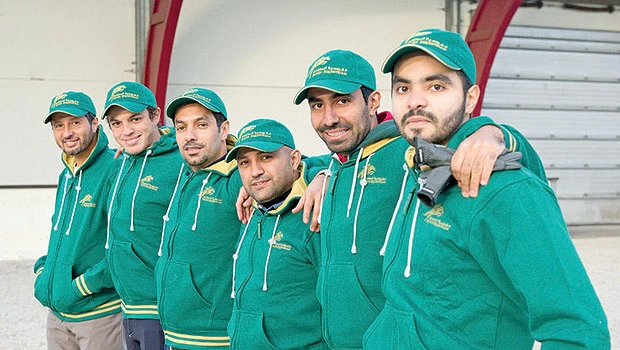
Trainers, coach, grooms and support staff are all part of the team structure and are essential in getting the four selected riders out of the six in the team to the Olympics.
“They have an enormous talent. They have fantastic horses and those guys are very dedicated to the program,” said Christine Traurig, the team’s dressage coach. “All of them have enormous talent and coupled with the quality in horses, there is basically nothing standing in their way of being successful.”
Traurig should know. She has known the team for a long time and is also one of the most highly respected and sought-after trainers and clinicians in the US. Born and raised on her parents’ farm near Verden, Germany where her father was a breeder, she began riding before she could walk. With long-time partner Etienne, Traurig was selected to represent the US on the dressage team at the Sydney Olympics. There she and Etienne earned their best score ever, enabling the US to clinch its third consecutive Bronze medal at the Olympics. Largely on the strength of that performance, Traurig was named the US Olympic Committee’s Female Equestrian Athlete of the Year in 2000.
“It’s wide open and they have got a real chance at the Olympics. Of course, everybody needs luck. Every team needs luck,” she opined.
The horses and the riders needed to stay healthy. The best horses were only as good as the way they had been trained and maintained health wise. “And the best horse is only as good as the rider rides it and vice versa: a good rider is only as good as his horse,” she concluded.
When the riders enter the jumping ring at Doha, they and their mounts should be in the best physical and mental condition possible. To get there years of riding experience, natural talents of horse and rider, training and thousands of hours of coaching, often in bleak cold arenas in the early dawn, have played their part.
“There is a tremendous amount of work behind the scenes,” observes team coach Stanny van Paesschen. “And in our sport, far more than other sports, you have the factor of luck. You know,” he mused, “luck can come in a certain way: you can touch a fence and it stays or another time it can fall.”
Van Paesschen brings a wealth of competitive experience to the Saudi team. He participated three times in the Olympics (bronze medal team in Montreal, involvement in Atlanta and Athens), the World Games (bronze medal team at the Games in Jerez) and competed in many Nations Cups.
In 2010, under his leadership, Saudi Arabia won the individual silver medal in the World Games in Lexington and the gold medal in individual and team events at the Asian Games in Guangzhou.
On Wednesday, December 21, the team showed a little more of its huge potential by scooping gold for the equestrian team final in a jump off at the Pan Arab Games in Doha. Saudi Equestrian will compete at next week’s CSI4*-W Olympic Qualifier in Doha, Qatar (Dec. 27 – 30), where they are expected to officially qualify for the 2012 Olympic Games.
“Their teamwork has been exemplary and they deserve all of the success that comes their way,” said coach Van Paesschen, adding that the Saudi team today was one of the strongest if everything went in the right direction. “There are still areas where we can do things better. We have, though, a very professional team behind us.”
But first, there is the Doha final qualifier.