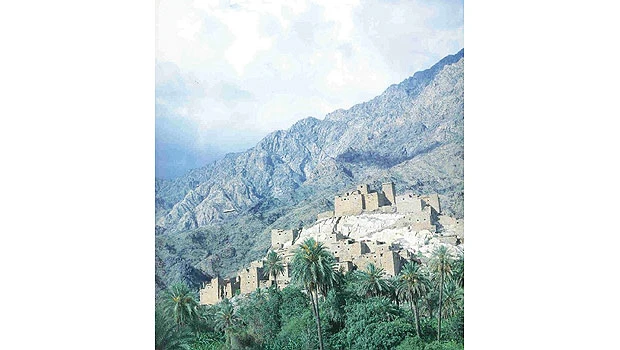
- JEDDAH: Dhee Ein, one of the most unusually situated villages in the Kingdom, is to be saved by its residents.
One hundred men, young and old, who constitute the entire male population of the village, have formed a cooperative committee to preserve the historic character of their village, which was established more than 400 years ago.
Located about 24 km to the southwest of the southern city of Al-Baha, the village has 31 houses, a small mosque and a number of fortresses that were built to protect it.
The village is built on the top of an outcrop of white rocks in the base of a high-sided valley, and is reachable only by foot. The houses, some up to seven stories high and roofed with palm leaves, are made of local stone transported on camel backs from the nearby mountains.
The stone frequently contains quantities of marble and the outcrop the village stands on is largely and uniquely white marble. The village derives its name from the spring that flows from the base of the marble outcrop.
It is an ongoing rule and a tacit custom that no one shall be allowed to enter the village after Maghreb prayer and those inside it who want to leave must do so before sunset.
In the late afternoon as the sun sets over the mountain ridge, the marble hill glows white, giving the illusion that the village is floating on clouds.
Visitors are also forbidden to collect stones or antiquities from the village, which has four guards watching it around the clock.
Chairman of the Saudi Commission for Tourism and Antiquities Prince Sultan bin Salman said he had visited the historic village some time ago and was asked by the residents to allow them to demolish their old houses and build new ones in their places. “I told them to leave the houses as they were and to go down to the valleys to build their homes,” he said.
The prince said few days later the villagers came to him and told him that they had formed a cooperative committee for the protection of the historic nature of their village and that they could not live with clear conscience if they destroyed their own history.
A spokesman for the committee said their first priority would be to keep their village intact, then to market their agricultural products, find job opportunities for their young and support small enterprises for productive families.