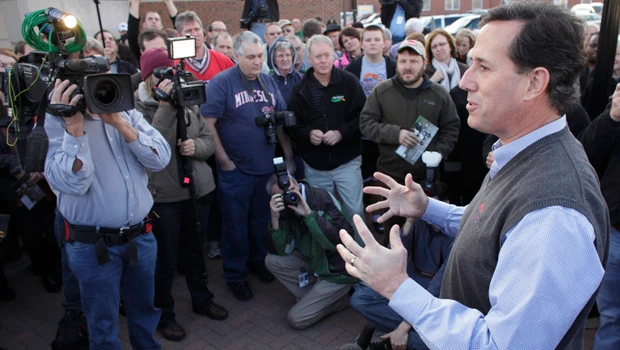
- WASHINGTON: Republican contender Rick Santorum says that if he’s elected president, he would bomb Iran’s nuclear facilities unless they were opened up for international arms inspectors.
The former Pennsylvania senator says President Barack Obama hasn’t done enough to prevent the Iranian government from building a nuclear weapon and has risked turning the US into a “paper tiger.”
Santorum told NBC television’s “Meet the Press” that he would tell Iranian leaders that either they open up those facilities, begin to dismantle them and make them available to inspectors — or the US would attack them.
The Obama administration, like President George W. Bush’s administration, has focused primarily on international diplomacy and economic penalties to try to pressure Iran into abandoning its nuclear program. Iran contends its efforts are for peaceful purposes.
Santorum — a hero among social conservatives — is surging and libertarian-leaning Texas Rep. Ron Paul is sliding in a contest that remains incredibly fluid.
Santorum’s surge into top-tier contention has not gone unnoticed by his rivals who have stepped up their criticism of him in hopes of slowing his momentum after ignoring his candidacy for months. Santorum defended his record in Washington and cast himself as the most electable conservative alternative to Mitt Romney.
Romney, the former Massachusetts governor, is the clear front-runner in Iowa, but polls show the volatile Republican race in the Midwestern state could be decided by which way undecided voters break in the two days before the first votes are cast in the 2012 presidential contest.
With the leadoff Iowa caucuses looming Tuesday, Romney is contending for victory in a state that eluded him in the presidential race four years ago.
Texas Gov. Rick Perry and Minnesota Rep. Michele Bachmann, both lagging in the polls, tried to make their case Sunday to peel conservative votes away from Santorum, whose meticulous campaigning across Iowa and wooing of social conservatives appeared to be paying dividends at the finish line.
On Sunday, the candidates were making their closing arguments, both in appearances across Iowa as well as on national television, while volunteers and staffers canvassed the state to start mobilizing backers and woo the undecided.
With many factors at play, the dynamics can shift rapidly as the Republicans try to choose a candidate to challenge President Barack Obama in the November election. Polls show Obama is vulnerable as he seeks a second term, weighed down with voter dissatisfaction over his handling of the economy and the sputtering recovery from the recession.
Yet, two things were clear on the final weekend before the Iowa Republicans gather in precinct caucuses in their communities: The yearlong effort to establish a consensus challenger to Romney had so far come up short, and Romney’s carefully laid plan to survive Iowa may succeed because conservative voters have so far failed to unite behind one candidate.
“It may be Romney’s to lose at this point,” said John Stineman, an Iowa Republican campaign strategist. “And it’s a battle among the rest.”
Only three or four candidates typically make it out of Iowa with enough momentum and money to continue in the race.
Underscoring the unpredictability of the race, a new poll by The Des Moines Register newspaper showed that a remarkable 41 percent of likely caucus-goers say they were undecided or still might change their minds.
Romney had 24 percent support among likely voters in Iowa while Paul had 22 percent, meaning they were statistically even at the front of the pack. Santorum was third with 15 percent, followed by former House Speaker Newt Gingrich, with 12 percent, and Perry, with 11 percent. Bachmann, a one-time Iowa favorite, had just 7 percent support even though she was born in the state.
The poll’s margin of sampling error for the full four days was plus or minus 4 percentage points. For the last two days, it was plus or minus 5.6 percentage points.
The poll showed Santorum gaining ground and Paul slipping a bit as rivals hammered him on his noninterventionist foreign policy views. Paul opposes intervening militarily to prevent Iran from acquiring nuclear weapons, advocates withdrawing US troops from Afghanistan, and wants to end US aid to Israel and other allies.
Paul, who spent the weekend at his home in Texas, stood firm on his contention that the US should not bomb Iran if the country is developing a nuclear weapon.
“I would say that we just need to be more cautious. I think if we overreact and participate in bombing Iran we’re looking for a lot more trouble,” Paul told CNN’s “State of the Union.”