- TEHRAN/PARIS: France said on Monday that Iran’s testing of missiles near the strategic Strait of Hormuz was regrettable and reminded Tehran of the need to keep the vital oil transit waterway open.
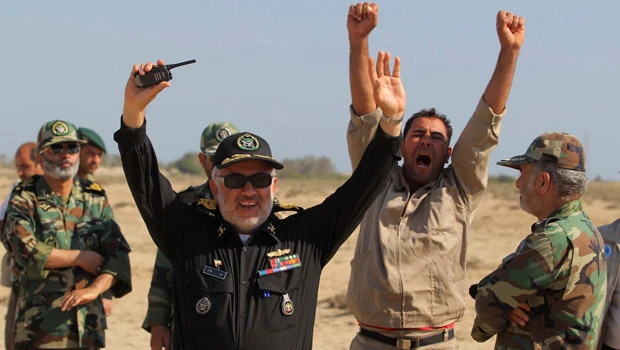
“We regret the very bad signal sent to the international community by the latest missile tests announced by Iran,” Foreign Ministry spokesman Bernard Valero said. The launch of two missiles took place on the final day of war games in waters east of the strait at the entrance to the Gulf, an Iranian Navy spokesman, Mahmoud Mousavi said.
The longest range of the missiles tested Monday was some 200 km. The missile tests renewed concerns over what Iran might do if it felt cornered. Mousavi said a Qader ground-to-ship cruise missile and a shorter-range Nasr surface-to-surface missile were launched in the tests. The Qader cruise missile “built by Iranian experts successfully hit its target and destroyed it,” Mousavi said.
On Monday, Iran’s currency hit a new record low to the US dollar on Monday, two days after President Barack Obama signed into law a bill targeting Iran’s central bank as part of the West’s efforts to pressure Tehran over its nuclear program.
The semiofficial Mehr news agency said the Iranian currency’s exchange rate hovered late Monday around 17,800 rials to the dollar, marking a roughly 12 percent slide compared to Sunday’s rate of 15,900 rials to the dollar. The rial was trading at around 10,500 rials to the US dollar in late December 2010. The currency has lost 53 percent of its value over the past year.
The report said Iran’s central bank called on Iranian experts to meet Wednesday to discuss the turbulence in the currency market.
The bill Obama signed on Saturday includes an amendment barring foreign financial institutions that do business with Iran’s central bank from opening or maintaining correspondent operations in the United States. The Obama administration, however, is looking to soften the impact of the measure, fearing they could lead to a spike in global crude oil prices or pressure key allies that import Iranian oil.
Iranian official warned last week that the Islamic Republic could easily close the Strait of Hormuz, through which a sixth of the world’s oil passes, if the new measures are applied. But analysts and diplomats have downplayed the warning as little more than bluster on the part of Tehran.
The country relies on oil exports for the overwhelming majority of its foreign revenues and shutting the strait would not only affect its oil, but also raises the possibility of a military confrontation.
Iranian officials have downplayed the new US measure, with Economy Ministry Shamseddin Hosseini quoted by Mehr as saying that targeting the central bank was an “unsuccessful choice.”
Mahdi Ghazanfari, Iran’s trade and industry minister, argued that the “enemies of Iran will not achieve any result through imposing sanctions” on the bank, while the bank’s governor, Mahmoud Bahmani said “the world will laugh at the US for imposing sanctions on Iran’s Central Bank.”
The hike in the exchange rate Monday led money changers to stop trading currency, apparently hoping for higher rates in the coming days.
Merchants said Monday that the hike in dollar exchange rate has led to shortages in some supplies.
Saeed Mahmoudi, a barber, complained that he could not find reasonably priced hair clippers from suppliers. “Only one of them offered a single imported clipper for 600,000 rials, about twice of the price from the same trader one week ago,” he said.
The pressure on the riyal is the latest example of the economic difficulties the country is facing as the US and its allies seek to ramp up pressure over a nuclear enrichment program they maintain is aimed at developing a weapon. Iran says its program is purely peaceful.
President Mahmoud Ahmadinejad said last week his administration will do everything it can to stave off further steep depreciation in the riyal’s value, signaling that the government could prop up the currency using its hard currency reserves.
Oil sales have allowed Iran to build up a nest egg of tens of billions of dollars.The country earns more than $70 billion from exporting crude per year, some 80 percent of its annual foreign revenue.
Ahmadinejad has already come under fire for cutting subsidies on fuel and food. The step is aimed at reducing government spending while also distributing money directly to the poor. Critics contend, however, that the cuts will do little more than stoke inflation.
Reflecting possible concerns about liquidity and the flight of hard currency, Iran over the past few months has restricted cash withdrawal and allows those traveling outside the country to take with them only $2,000 a year.