
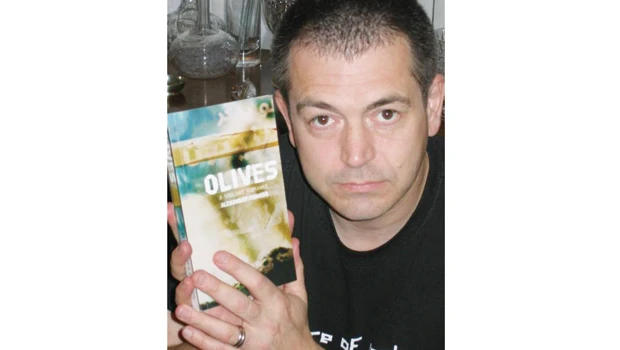
- Alexander McNabb, the UAE-based author of the blog “Fake Plastic Souks,” (fakeplasticsouks.blogspot.com) has finally gotten around to self-publishing his first novel, “Olives — A Violent Romance,” which he wrote about a decade ago.
- Goodreads.com lists Olives as a “mystery and thriller” and the book has garnered a 4.75 out of 5 rating among readers.
Why did it take so long for McNabb’s words to reach an audience? Mostly because he spent ten years trying to get it published through conventional means.
“When I started writing ‘Olives” conventional wisdom was that you would have to get a literary agent to get publishers to talk to you,” he explained. “You’d submit a query letter first to an agent and then if you were lucky, they’d ask you for the first three chapters or the first 50 pages of your book. Next, if you were very lucky they’d ask you to send the full manuscript and later, if you were extraordinarily lucky, they’d sign you. After that, if things went really well they’d send your manuscript to editors at publishing houses and only then would there be a chance of the book being published.”
According to McNabb, any given literary agent in the UK receives upward of 40 queries a day from authors. Agents in the US can get 100 to 200 queries daily. This means the odds are pretty slim that any manuscript will attract an agent’s attention. Another issue he faced was that those agents who would take a glance at his manuscript told him that Olives wasn’t dramatic enough to be a thriller. As a story that combined romance, mystery and suspense, the novel didn’t fit comfortably into the pigeonhole genres that are safe for publishers when they’re considering backing a book.
“As the years went by, I picked up a lot of rejections,” McNabb said. “By the time I eventually got signed by a literary agent in London, I’d already been rejected 250 times; six times in fact by the agent who signed me.”
Signed by an agent, McNabb found himself and his novel in 2011, a time when the publishing industry was undergoing some of the most fundamental and shocking changes in its history.
“By the London Book Fair of 2011, publishers had woken up to the fact that the world had changed and it hadn’t been bothering to wait for them to change it. Amazon.com has changed the publishing game beyond recognition” McNabb remarked. “The Internet enables an author to reach an audience globally. It doesn’t have to be locally and it doesn’t have to be through bookshops or through the physical distribution of books by publishers. In fact by last year’s London Book Fair, 40 percent of US core readers, individuals who buy more than 12 books a year, were using e-readers and not paper books.”
But publishers have been slow to embrace digital distribution and the largest publishers keep trying to find ways to make the old model work. McNabb pointed out that major publishing houses use their sales of e-books to subsidize their print operations. A major publisher will charge $10.99 for an e-book, whereas tens of thousands of individual authors on Amazon.com are selling e-books for $2.99. In a tough economy people are buying from Amazon and not bookstores. Independent publishing houses are reaching out to support authors in ways that big publishers never would. The whole model where there were gatekeepers to decide what books would eventually be published for people to read is being blown apart by the Internet. Attitudes have changed as well and self-publishing has become respectable.
“When I started down this road, self-publishing was something you did for vanity. It was seen as slightly contemptuous,” said McNabb. “Now it seems to be a more viable route to market. My social networks in the Middle East are well-developed platforms that allow me to reach people who might be interested in what I write. Olives appeals to Arabs all over the world and through Amazon I can actually sell to an Arab in California or an Arab in a Gulf country or somebody of Arab descent in London. I can sell those three books instantaneously, over the Internet and I don’t need to stock books in all those countries, which traditional publishers still do.
Despite the proliferation of e-books and e-book readers, McNabb felt compelled to create a paperback version of Olives specifically for readers in the Middle East. He explained that this was because of Amazon.com’s lack of support for the region.
“I am furious that Amazon will not support the Middle East because it’s holding us back in the Dark Ages culturally,” said McNabb. “Everybody in the US and the UK are using Kindles and accessing cheaper e-books which are so much more efficient in every way, but Amazon denies that option to the people in the Middle East. Because of Amazon’s policies, the young people here are denied the choice to use this marvelous new media with the wonderful access that it affords.”
Everyone can purchase Olives in paperback through Amazon.com ($15.99) and it is available through Jashanmal in the UAE. As an e-book, get it from smashwords.com for $5.99. McNabb is very satisfied with the self-publishing experience. He found that through the Internet he was able to access all the talented professionals he needed to polish his manuscript and bring it to the public. The book was edited by an experienced editor in Ohio, USA. McNabb selected an artist he admired to create the cover. He was able to keep all the rights to his work and assign them as he sees fit. While he expects to spend thousands of hours promoting the book himself, he discovered that these days even authors who sign with major publishers are expected to do much of the promotional work themselves.
And his advice to those of us who would be authors:
“If you want to go the commercial route and find a commercial publisher who will be interested in you, write a book specifically in a genre such as chick lit or crime fiction that will sell well in supermarkets,” McNabb said. “If you don’t necessarily want to be the next Rose Tremain or JK Rowling, go and do your own thing; write something that you’re passionate about. Send it to ten literary agents. If they reject you, go to self-publishing straight away. There are forums and advice out there and it’s really simple to get your words out into the hands of readers. Don’t waste time and effort like I did. Maybe only 100 people will read my book, but because I self-published that’s 100 more people who will read it then when it was lying in my cupboard.”