- An Iraqi political analyst has confirmed that Iraq was witnessing political and security deterioration and that Iran was tightening its grip over his country.
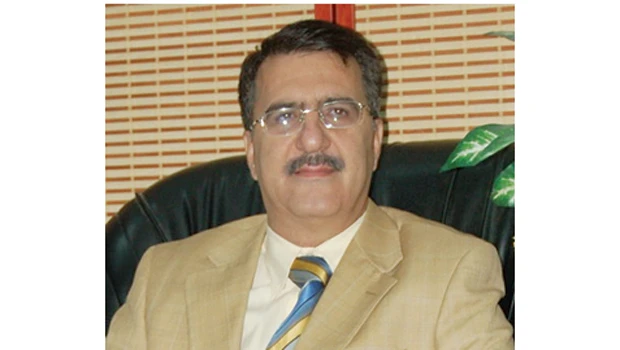
Dhafir Al-Ani, a leading figure in the political party Iraqi List, said what is happening right now with regard to Vice President Tariq Al-Hashemi and Deputy Prime Minister Saleh Mutlak shows that the pullout of US troops only played to Iran's advantage.
Al-Ani, in an interview with Arab News, said Iran, in consolidating its control in Iraq, is driven by fears that its closest ally in Syria may fall, an event that will have grave consequences for his country.
The interview:
I think that there are a number of reasons that pushed Iran to tighten its grip over Iraq. The American role in the region is on the decline.
Also, Iran is concerned about the possibility of a regime change in Syria. If such a thing materializes, then Iran will sure lose its strategic ally. Iranians think that the consequences of a regime change in Syria will be grave for its security and internal stability.
Tehran also thinks that American decisions will be free from Iranian influence in the aftermath of the US withdrawal from Iraq.
Of course, Iran could have hurt the American army in Iraq. Indeed, it did so, but it accused the Sunni and the national forces of some criminal operations.
Obviously, Iraqi Prime Minister Nuri Al-Maliki has been targeting the Sunni and national forces. In the first place, he implemented the de-Ba'athification.
Then he used Iran to target the Sunni and the national forces. Yet, I do believe that the Iranian alliance in Iraq will be the losers in the long run especially when it becomes crystal clear that this alliance is nothing but a tool for Iran.
Now national forces are aware of this fact, as sectarian policies are obvious in Al-Maliki's security and political behavior.
Well, Iran was controlling Iraq even during the American army’s presence in the country.
The Americans were caught between Iran and pro-Iranian forces on the one hand, and the national forces that called for the American withdrawal on the other hand.
The American army was a hostage in Iran's hands. Obviously, Iran sought to maintain the American occupation in Iraq. But the Americans’ eventual exit forced Iran to declare its objectives and ambitions.
Against this backdrop, I expect that Iran will ignite a sectarian war in Iraq. Of course Iran will not mind putting an end to this war in case the West reaches an understanding with Tehran with regard to the survival of the Syrian regime.
Iran has been preparing for this war from day one. What happened with Tariq Al-Hashemi and Saleh Al-Mutlak is a clear indication of the new dictatorship in Iraq.
Iran believes the collapse of the Syrian regime will be a precursor for its own political collapse. Also, Tehran is aware that America is free now and that the Iranian regime is targeted. For this reason, Iran supports the Assad regime with Iraqi money, provides it with intelligence and Revolutionary Guards, and supports it economically and logistically.
On top of that, Iran imposed certain policies on Iraq to serve the former’s interests. Not surprisingly, Iran will support more tough policies in months to come and Iraq will perhaps experience a sectarian war. This will be within the context of Iranian negotiations with the West with regard to Assad.
We have to be honest here. Iran offered great services to America in Iraq. Perhaps Washington fell into an Iranian trap. See for instance the outcome of the occupation!
Democracy is deformed, it is sectarian, and the political process is under control. For this reason, I rule out that Iraq will witness stability.
It is no wonder why some governorates start referring to themselves as regions so that they can get away from the control of the sectarian government in Baghdad and Iran.
Unfortunately, this direction only emasculates Iraq and reinforces the Iranian presence. Besides, Iran is using Iraq as a tool to undermine Arab security.
This was obvious through interfering in Arab countries' internal affairs, backing the Assad regime, undermining Lebanon's stability, etc. Now, how can Arabs restore their role in Iraq?
I call on the Arab countries to restore that role by restoring the national equation in Iraq, and by limiting the Iranian influence in Iraq. Arabs should be biased toward the Iraqi national forces regardless of their different outlooks and directions.
We have to admit that ever since the Khomeini, Iran has ambitions in the Arab region. All of its policies toward the Arabs stem from this ambition.
To that end, Iran has been using its various tools to achieve an intelligence and security breakthrough.
Unfortunately, it managed to penetrate some Shiites who are loyal to Iran. Mind you, Iran behaves differently when it comes to its own borders and affairs. It is here that Iran demonstrates rationality and diplomacy. I do not think that Iran will ever be stupid in closing off the Strait of Hormuz even if it possesses the material capability to do so. Needless to say, Iran will punish itself if it ever closes off the Strait.
What is happening is nothing but muscle-flexing to force others to negotiate with Tehran. Iranians believe that Washington as well as the Gulf countries will talk to them.
Interestingly, this rationality is absent when it comes to places away from their own borders! This is evident in Lebanon, Gaza, and Yemen. This is where Iran pushes for bloody confrontation. But mind you, Iran's leaders do not want to see their country’s relationship with the West culminate in a bloody clash.
The Gulf countries must be aware that regional security is an integrated system even within the GCC. There’s a need to learn from the Iraqi lesson that unity is strength.
Prior to 2003, Iraq was a source of security for the Gulf regardless of the mistakes that took place. I am saying this because Iran's ambitions are old and renewable.
These ambitions were given relevance with the advent of Imam Khomeini. Fortunately, Iraq managed to put Iran in check during the 1980s. Therefore, leaving the stage in Iraq for Iran hurts Gulf security.
Obviously, Iran is intent on striking at Iraq's Arab depth unless the Arab countries and the Gulf countries in particular support the Iraqi national forces to bring about a balance to this formula.
Iraq was a red line that Iran used to fear. However, Iraq has become today the head of a spear to undermine Arab security. As far as relations with Iraq are concerned, I think that basing these relations on economics will not realize the strategic objectives.
I believe that the basis of these relations is not economics but pan-Arab security. Iraq is a strategic point that should not be sacrificed, particularly amid Iran's current hegemony in Baghdad.
The United States is looking at Iraq from an economic angle. Iran, on the other hand, is looking at Iraq from political and sectarian perspectives.
Iran will continue its current policy as long as leaders in Tehran believe that Iraq will help them survive. As I said, Washington is only interested in its economic and oil interests and therefore it will turn a blind eye to the political process.
On the contrary, Washington is bargaining with Nouri Al-Maliki using the card of supporting national forces to gain more influence in its economic interests.
Unfortunately, this is the case despite the existence of some voices in Washington calling on the American administration not to overlook the need to limit Iranian influence in Iraq.
We should not ignore the services that Tehran offers the West. By alienating the Arabs and interfering in their internal affairs, Tehran is pushing the Arabs to embrace the West.
Well, despite its appearance, Iran is living in a state of worry and internal weakness. Iran is afraid of others interfering in its internal affairs.
Had the Arabs cultivated winning bargaining chips inside Iran, the equation would have changed. Therefore, the strength of Iran has to do with our lack of use of all available cards. We should always remember that when Khomeini took over in 1979, Iran was prepared to confront the Soviet Union. Yet Iraq gave it a bloody nose.