
- JAIPUR may well be known as the Pink City, but here are places of contemplative beauty.
- It is a city of gems, stones, history, architecture, tradition, national integrity and insatiable dreams.
Jaipur makes the essence of simplistic beauty come alive. You are never far away from home even if you are on a map. You are in a different state, region and zone but that in itself is a dream. Greeted by the warm Indian hospitality, Jaipur will leave you immersed in a dream-like state, which makes you love its idealistic beauty and hook you to the surreal home to Maharajas (Kings). Palaces, forts and museums, every spec of glamor, every monument sprinkled with insatiable powder remains to be standing tall in Jaipur's pride.
People envelop you with poise, ethnicity and ritualistic love like none other. Jaipur is the city of royalty and the infrastructure and set up of the Pink City is regal in every facet.
The heavy majestic interiors and exterior exuberance speak of the past retelling tales of Rajputs and Mughal dynasty. Rajputs are descendants of one of the major ruling warrior classes in the Indian subcontinent, particularly North India.
The city is name after its founder, Maharaja Jai Singh, one of the greatest warriors, and is the capital of the state of Rajasthan. Pink is traditionally a color associated with hospitality that is deeply ingrained in Jaipur's identity. It is filled with buildings that are a tint of red as they are immersed with color that resembles red sandstone architecture of Mughal cities.
Jaipur is a real-life guide to what the majestic Indian empire breeds of. You can envision the rich grandeur and hospitality with the domes, forts and rooms of the massive palaces. Not only does the city brink of rich heritage, but there is also a clash of flamboyance and beauty equivocally maintained in the little Kingdom of aristocracy. It was planned with scientific principles and doctrines of “Shilpa Shastra,” which was the ancient architectural manual used to plan what still remains India's most well-planned city. With a population of more than 3.1 million, Jaipur's home-spoken language is Hindi.
Jai Singh's lineage traces back to the Rajputs who fought with the Mughals during the early reign. Jai Singh, aligning himself with other Rajput states, had reinstated power and belief in his people and served them with nationalistic pride. After his death and during the war of independence, even though prior good relations with the British Raj were maintained, Maharaja Ram Singh bestowed Jaipur with the alias "Pink City" as he painted the entire city pink to welcome the Prince of Wales (later King Edward VII) to the city. In 1922, Man Singh II, Jaipur’s Maharaja ascended the throne and installed public amenities like schools, hospitals and other public buildings. After India regained independence, Jaipur merged with the states of Jodhpur, Jaisalmer and Bikaner of Rajasthan. Festivity, jewelry, textiles and prints, as well the rich taste in the versatile foods, are uniquely Rajasthani. Colors, enchantment and royal fervor are three facets Jaipur is very proud of.
From Amber Palace and Jaigarh Forts to ancient royal gardens to street shopping at Hawa Mahal, you have a lot of ethnicity to absorb. March your way up to Jaigarh fort or pass by Sheesha Mahal (palace of mirrors) or where the majlis would adhere to King. The Diwan-e-Khas is an open courtyard of a private audience for the important figures of society and royalty would meet with lofty brass and wooden doors, Diwan-e-Khas is put up on elevated pillars, as opposed to the Diwan-e-Aam (for the common people) which was suspended within the magnificent palace's courtyard and flourished with rhetorics, royal speeches and hearings of "the common man's problem" in the Kingdom. Flat-roofed pavilions, calligraphy and mughal rich state empire structures are stunning and reminiscent of Rajput tradition.
Definitely visit Chokhi Dhani, a five star ethnic resort, located on Jaipur-Tonk highway, around 18 km from the city center. You can enrich yourself with the rich taste of Rajasthani culture and tradition within that vicinity with your loved ones. You can watch live folk dances, listen to live folk music and get yourself embellished in Rajasthani attire, handcrafted and hand-painted accessories with body art (henna and paints). You can even hail an elephant, settle for a camel or bullock cart ride and then head for the most surreal meal of your life. Enjoy a hard core experience of traditional, vegetarian food in a thal on the floor while the people dressed in beautiful Rajasthani attire in turbans or women in dark-colored silhouettes serve you like there is no tomorrow. It gives you a glimpse of culture from different parts of Rajasthan. This brings food for thought on the table. Try their Lal Maas if you think you can handle spices. This will bring you to tears of joy. Unique Rajasthani cuisine to indulge in: Dal Batti Churma, Ghewar, Mirchi Bada, Missi Roti, Feeni, Gajak, Chauguni ke laddu and Moong Thal.
Indian movies, Hollywood weddings — everyone is bewitched by the grandeur and prime edifices and realm of the harmonious synthesis of Mugal and Rajasthan style structural designs of Jaipur monuments. You have heard tales of splendor, wars and riches of the Maharajas. Fascination is synonymous with their Kingdom. You walk through the passages of what were once filled and kept innate for royalty and their humble courtiers. Yet you can’t help but wonder of aristocracy and the far reaching out essence of Mughal dynasty on the city. Seeing the precarious, yet versatile, nature of people, cultures and religions immersed in one blood and in harmony, Jaipur is a state-of-the-art development.
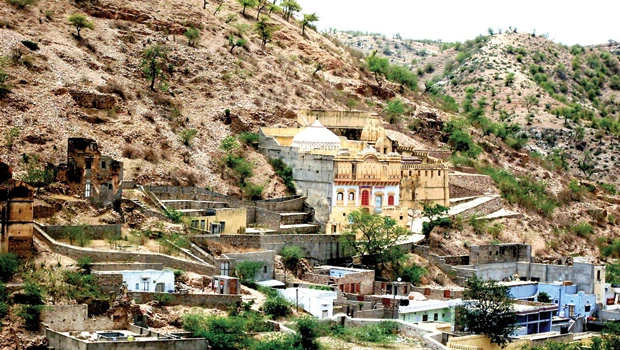
From the towering Amber Palace, you can spot the huge golden and yet frugal entanglements of houses all over the mountains surrounding the palace. You can tell the high fort around the palace was built to keep out the invaders guarding the beloved city from invasion, the stretch and size is beyond our comprehension. You look out to something more nostalgic — the tolerant being of the city as a temple and mosque exist side by side standing tall and eminent, as homes cluster around the fine mountains are close to crumbling, yet the people co-exist and live life like kings did with passion, pride and relentless belief.
There is nothing ordinary about the soul of this city. Playback to magnificently beautiful era in history and relive the real grandeur as you enter the Maharajas’ kingdom: only fit for a king.
• Jaigarh Fort (it holds a theatrical show with lights and sounds that will leave you mesmerized with the historic feat and creation of Rajasthan. Nahargarh Fort City Palace, Hawa Mahal, Amber Palace, Jal Mahal (A Rajput style architectured palace sits in the center of the Maan-sarovar lake — absolutely breathtaking), Sisodia Rani Palace and Garden, Sheesh Mahal, Mubarak Mahal and Chandra Mahal, Moti Doongri (a Scottish-style palace on a hill).
• Albert Hall (Central Museum), Amber Palace, Jain Mandir, Galtaji Temple Museum, Akshardham Temple, Govind Devji Temple, Lakshmi Narayan Temple, Anokhi Museum of Hand Printing, Shila Devi Temple
• Ram Niwas Garden, Samode, Zoological Garden (Jaipur Zoo), Central Park, Vidyadhar Garden, Jhalana and Nature Park (Nahagarh Biological Park).
• Chand Pol (Moon Gate), Ridhi Sidhi Pol (doorway structure with four entrances representing the four seasons) and Jantar Mantar (the largest of five astronomical observatories built by Maharaja Jai Singh during 1727-1734 in north India).