
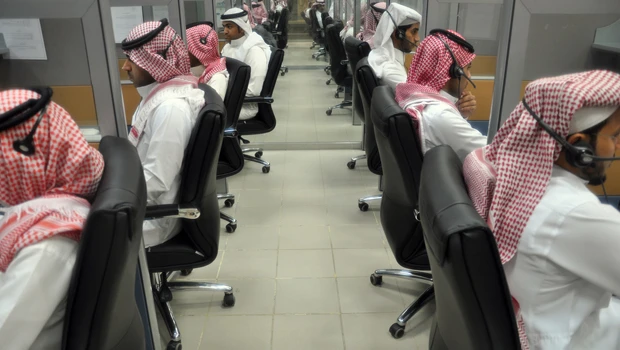
- A decade ago in Saudi Arabia people had to physically go to businesses or government organizations in order to avail themselves of customer service.
- But technology has changed the availability of customer support resources for the better.
Call centers depend on three elements — technology, business processes and human resources. If any one of the three is less than adequate, the service provided by the call center won’t make customers happy. In the last few years, connectivity has improved in Saudi Arabia and professional call center management companies have entered the business, so technology and business process issues have largely been resolved. That leaves the quality of service provided by call center employees as the major variable in this customer support channel.
Safwan Al-Khatib, managing director of Smart Link Contact Centers, explained that more than 85 percent of the call center projects in Saudi Arabia are staffed by Saudi human resources. In fact non-Saudi employees are only found in Saudi call centers where there is a requirement for languages other than Arabic to be offered in the customer service options. Saudi women are increasingly important as call center employees. In 2005, the ratio for agents was 70 percent men and 30 percent women at call centers operated by Smart Link. By 2011, more than 60 percent of the agents at Smart Link call centers were women.
“Hiring Saudi women is part of our success story,” said Al-Khatib. “Women are better employees in call centers for many reasons. They are more loyal. We can retain their services for longer periods so they are more experienced with clients’ products and services. They have better sales skills than men. Women agents offer a better value for our clients and better service for customers.”
Smart Link invests heavily in the training of new employees, many of whom have never held a job before. The majority of call center staff has graduated from high school but most don’t have university degrees. Al-Khatib believes that one of the services that call centers provide to the society in general is to give young Saudis experience in a professional work environment and to introduce them to the importance of competent customer care. He noted that Saudis tend to find the working conditions at call centers acceptable and that cooperation with the Human Resources Development Fund (HRDF) has resulted in competitive starting salaries for call center agents.
“There is a high unemployment rate among Saudis who have completed high school but not attended university. Call centers offer people a great chance to launch their careers,” said Al-Khatib. “We don’t expect call center staff to stay with us more than two or three years. They will move on to higher paying jobs with more responsibility. This is especially true for Saudi men. The training we offer gives our staff skills that they then use in other jobs.”
Two to six weeks goes into training a new call center employee. During that time the employee learns basic business behavior and ethics. In-depth training is given concerning the product or service being handled. The employee also learns about human psychology to better manage the customers calling in for assistance. It all sounds quite straightforward but anyone who has worked in a customer service position knows how challenging those jobs can be. Al-Khatib mentioned as well that for call centers, the service is only as good as the experience of the last call.
Unfortunately, dealing with angry, shouting, foul-mouthed customers is an unpleasant aspect of working in a call center. Considerable time is spent educating new hires on the best way to manage furious customers. One point that is emphasized constantly in the training sessions is that angry customers aren’t upset with the call center employee personally. Rather, they are unhappy with the product or service of the organization represented by the call center. Employees learn techniques to calm upset customers and can trigger a request for assistance where a supervisor listens in on the call and offers advice or even takes over the call. Al-Khatib emphasized though that call center employees are never allowed to be disrespectful to customers and would be disciplined if they used profanity.
That doesn’t mean that bad behavior from customers is encouraged. Smart Links is particularly sensitive to any sort of harassment of women employees by customers calling in for service. “Harassment of women agents is unacceptable,” Al-Khatib said. “We used to suffer from this problem a lot two or three years back, but now the culture has changed and people treat women agents with respect. The Communications and Information Technology Commission (CITC) has a complete policy that addresses harassment calls. If the caller starts bothering one of our agents, we take immediate action. All calls to our centers are logged, recorded and monitored so we have the evidence needed in such situations.”
Smart Links is so confident in the cultural acceptability of employing women agents in their operations that when a call center was begun for the Hafiz program, they recommended that women be hired. Initially, a very small number of women agents worked handling customer queries for this government program in support of unemployed Saudi citizens. Now, more than 55 percent of the agents for the Hafiz call center are women.
Call centers in the Kingdom run under three models. Some are completely outsourced to companies such as Smart Link. Other organizations might choose to have Smart Link run the call center in-house, at a designated site. The final model is where businesses manage the call center site and technology on their own, but ask Smart Link to furnish the human resources and associated training. Which model an organization chooses depends on numerous variables, but completely outsourced call centers are becoming more common in Saudi Arabia. This is in part due to technologies that provide extensive operational reports, allow the client companies to monitor the facilities remotely through CCTV and even listen in on live customer calls.
“In their latest report for investors, CITC mentioned that call centers offer excellent investment opportunities in Saudi Arabia. I think the future is promising for this type of business,” advised Al-Khatib. “Saudi Arabia could play a big role in being the host of call centers for the GCC countries. This of course would create many jobs. What we do need though is for Saudi decision makers to consider call centers to be a commercial sector bringing enormous support to the nation, as is the case in Egypt and Jordan. With potentially more operators coming to this market, CITC needs to create clear standards for call centers. Government agencies must better coordinate policies and procedures so that the call center industry can grow for the benefit of the people of Saudi Arabia.”