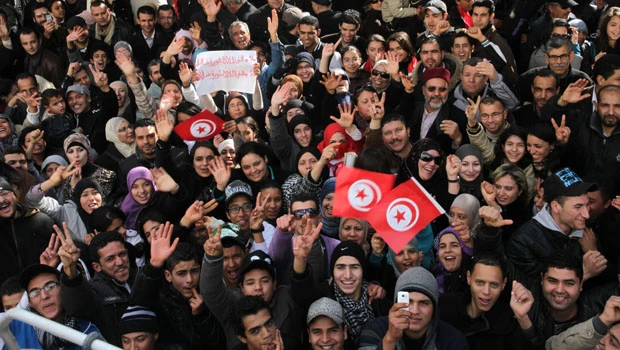
- TUNIS: Thousands of Tunisians marched in peaceful triumph Saturday to mark the one-year anniversary of the revolution that ended the rule of Zine El Abidine Ben Ali — and sparked uprisings around the Arab world.
Tunisia greeted the anniversary with prudent optimism, amid worries about high unemployment that cast a shadow over Tunisians’ pride at transforming their country.
Now a human rights activist is president, and a moderate Islamist jailed for years by the old regime is prime minister at the head of a diverse coalition, after the freest elections in Tunisia’s history.
Tunisia’s uprising began on Dec. 17, 2010, when a desperate fruit vendor set himself on fire, unleashing pent-up anger and frustration among his compatriots, who staged protests that spread nationwide. Within less than a month, longtime president Ben Ali was forced out of power, and he fled the country on Jan. 14, 2011.
Boisterous marches Saturday reflected the country’s new atmosphere.
On a crisp, sunny day in Tunisia’s capital, Islamists shouted “Allah-u-Akbar.” Alongside them were leftists and nationalists celebrating freedom, and mourning the more than 200 people killed in the month-long uprising.
Leading Arab dignitaries are joining Tunisia’s leaders for ceremonies to commemorate the anniversary, including Algerian President Abdelaziz Bouteflika — who faced down protests in his own country last year — and the head of Libya’s interim government, Mustafa Abdel-Jalil, who helped lead opposition to Muammar Qaddafi.
Tunisian media reported that the new leadership, to mark the anniversary, pardoned 9,000 convicts and converted the sentences of more than 100 prisoners from the death penalty to life in prison.
As the country that started the Arab Spring, Tunisia appears to be the farthest along in its transformation. Political analysts warn, however, that further gains will not be easy or painless.
Heykel Mahfoudh, a law professor and adviser to the Geneva Center for the Democratic Control of Armed Forces, said in an interview with The Associated Press that Tunisia is entering its second post-Ben Ali year “in a paradoxically necessary phase of turbulence.”
Mahfoudh says he is “cautiously optimistic” for Tunisia’s development, but remains worried about the country’s economic and social situation. It’s unclear, too, what the Islamists who won the elections will do with their power.
Unemployment has risen to almost 20 percent today from 13 percent a year ago, and economic growth has stagnated as investment dries up and tourism, once a pillar of Tunisia’s economy, evaporates.
Tunisia under Ben Ali was renowned among European tourists for its sandy beaches and cosmopolitan ways. But for many of its people, Ben Ali’s presidency was 23 years of suffocating one-party rule.
The revolution started when 26-year-old fruit-seller Mohammed Bouazizi set himself on fire in front of a town hall after he was publicly slapped and humiliated by a policewoman reprimanding him for selling his vegetables without a license. He suffered full-body burns, and died soon afterward.
The focus of the protests soon moved to the capital Tunis as tens of thousands braved tear gas and battled police along the elegant, tree-lined boulevards. And then on Jan. 14 it was over. After Ben Ali’s army refused to shoot protesters and his security forces wavered, he fled the country with his family.
Ben Ali’s departure immediately reverberated across the Arab world. Within hours, protesters took to the streets in Cairo, and within weeks, longtime Egyptian President Hosni Mubarak had also been forced out of power.