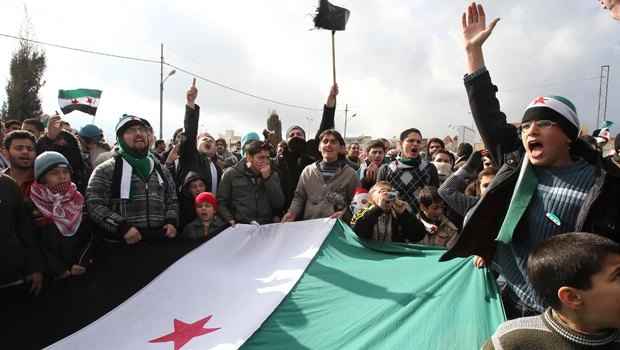
- AMMAN: Scattered violence broke out on Friday in Syria, where Arab peace monitors have completed a monthlong mission, as security forces countered protests against President Bashar Assad after Friday prayers.
Hundreds of people have been killed since the monitors arrived in Syria, where an armed insurgency has grown in recent months, contesting Assad’s grip on several parts of the country.
Arab foreign ministers meet in Cairo on Sunday to decide whether to prolong or end the observer mission.
Supporters say the mission reduced violence somewhat, but critics say it provided diplomatic cover for Assad to pursue a crackdown that the United Nations says has already killed more then 5,000 people.
The Syrian authorities accuse foreign-backed militants of killing 2,000 members of the security forces since the unrest began in March, inspired by Arab uprisings elsewhere.
French President Nicolas Sarkozy said “ferocious repression” of Assad’s opponents by the authorities was dragging Syria toward chaos and would only benefit extremists.
He urged the Arab League to intensify its monitoring efforts and called on the UN Security Council, so far paralyzed by divisions over Syria, to act.
Security forces prevented prayers at the Omari Mosque in the southern town of Daraa, where the anti-Assad revolt got its start 10 months ago, for the fifth Friday in a row, activists said.
The Syrian Observatory for Human Rights reported a heavy security presence around mosques in the port city of Latakia and said shooting had erupted in several other restive towns.
The British-based group said a security officer had been assassinated in Daraa, possibly because he had changed sides. In the northwestern province of Idlib, security forces returned the bodies of six people who had disappeared two days earlier. Two civilians were killed in other towns on Friday, it said.
It was not possible to verify the latest accounts of unrest in Syria, where tight media restrictions are enforced.
At a small pro-Assad demonstration near the Omayyed Mosque in Damascus, dozens of young men chanted: “We are your men, Bashar” and “Shabiha forever, for your eyes, Bashar,” a reference to a militia that operates alongside security forces.
Houssam Younes, an army conscript at the rally, said Assad should use “full force” to crush armed insurgents.
“The army is facing hell from them in Homs and Hama. We do not want reforms. We want to finish those terrorists first. The people should be united against them,” he told Reuters.
Sudanese Gen. Mohammed Al-Dabi, head of the monitoring mission, was expected to fly to Cairo, headquarters of the Arab League, on Saturday to report on what his 165-strong team has witnessed since it deployed in Syria on Dec. 26.
Burhan Ghalioun, head of the opposition Syrian National Council, was also due in the Egyptian capital, where he planned to meet the League’s secretary-general, Nabil Elaraby.
New York-based Human Rights Watch said the League should publish the monitors’ report in full and should urge the UN Security Council to impose targeted sanctions, including an arms embargo, to stop the killing in Syria. Russia and China oppose any UN sanctions on Syria.
Sanctions that have been imposed by Western countries, and disruption caused by the uprising, are taking a toll on the Syrian economy. Syria plans to introduce a managed float of its exchange rate, effectively devaluing the currency, its central bank governor Adib Mayaleh told the Financial Times on Friday.
The value of the Syrian pound has fallen by a third on the black market during the unrest, exchange dealers say.
A Western embargo on Syrian oil exports has cost the country $2 billion since September, the state news agency SANA quoted Oil Minister Sufian Alao as saying.
Alao said Syria was still trying to replace European Union crude oil contracts with new customers, but was having trouble securing shipping insurance and trade credit.
The EU, which bought most of Syria’s approximately 130,000 barrels per day of oil exports, imposed sanctions on Syrian oil on Sept. 2, following a similar decision by the United States.
Syrian oil exports are tiny when compared to those of the main Middle East exporters and the sector does not dominate the economy as it does elsewhere in the region, but it provides revenue the government relies on.
EU governments are expected on Monday to expand a Syria sanctions list against individuals, companies and institutions.
Alao also said attacks on oil and gas pipelines and other energy installations had killed 21 workers, disrupted supplies and caused damage estimated at 2 billion pounds ($34 million).