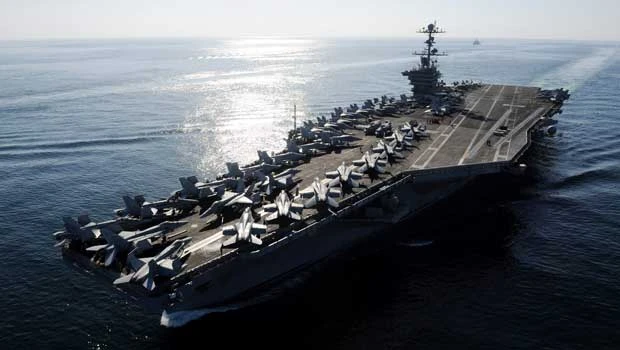
- TEHRAN: Iran’s Revolutionary Guard Corps said on Saturday it considered the likely return of US warships to the Gulf part of routine activity, backing away from previous warnings to Washington not to re-enter the area.
The statement may be seen as an effort to reduce tensions after Washington said it would respond if Iran made good on a threat to block the Strait of Hormuz — the vital shipping lane for oil exports from the Gulf. “US warships and military forces have been in the Persian Gulf and the Middle East region for many years and their decision in relation to the dispatch of a new warship is not a new issue and it should be interpreted as part of their permanent presence,” Revolutionary Guard Deputy Commander Hossein Salami told the official IRNA news agency.
The apparently conciliatory comments may be a response to the European Union and Washington’s rejection of Iran’s declaration it was close to resuming negotiations with world powers and with the Pentagon saying it did not expect any challenge to its warships.
Crude prices have spiked several times this year on fears diplomatic tensions could escalate to military clashes as well as uncertainty about the effect of sanctions on the oil market.
Along with the EU, which is set to agree an embargo on Iranian oil next week, Washington hopes the sanctions will force Iran to suspend the nuclear activities it believes are aimed at making an atom bomb, a charge Tehran denies.
There has been no US aircraft carrier in the Gulf since the USS John C. Stennis left at the end of December at a time when the Revolutionary Guard was conducting naval maneuvers.
On Jan. 3, after US President Barack Obama signed new sanctions aimed at stopping Iran’s oil exports, Tehran told the Stennis not to return — an order interpreted by some observers in Iran and Washington as a blanket threat to any US carriers.
“I recommend and emphasize to the American carrier not to return to the Persian Gulf,” Iran’s army chief, Maj. Gen. Ataollah Salehi, said at the time. “We are not in the habit of warning more than once.”
Washington says it will return to the Gulf and Defense Secretary Leon Panetta said any move to block Hormuz — through which around a third of the world’s sea-borne traded oil passes — would be seen as a “red line,” requiring a response.
Citing operational security, the Pentagon will not say when the next carrier will return to the Gulf but officials say it is only a matter of time and they do not expect any problems.
In the coming days or weeks, the Revolutionary Guard will begin new naval exercises in the Strait of Hormuz and the Gulf.
Salami told IRNA these would go ahead as planned in the Iranian month of Bahman which runs from Jan. 21 to Feb. 19. Iran has said it is ready to return to talks with world powers that stalled one year ago, but the West, concerned about Tehran’s move of the most sensitive atomic work to a bomb-proof bunker, says it must first see a willingness from Tehran to address the nuclear issue.