
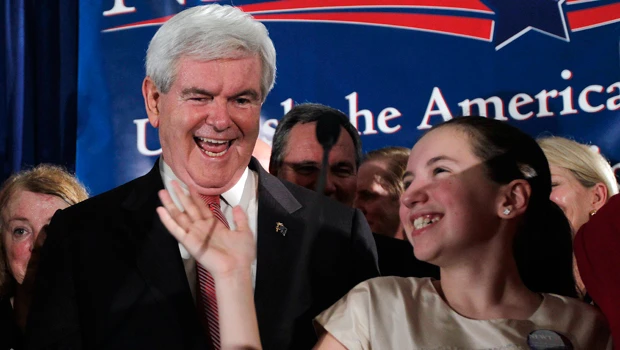
- WASHINGTON: Newt Gingrich trounced Mitt Romney in South Carolina’s Republican presidential primary, upending the battle to challenge President Barack Obama in November and reviving a campaign that has twice been near collapse.
Stung by the worst week in his campaign, Romney told Fox News on Sunday that he will release his 2010 tax returns and 2011 tax estimates Tuesday, and said it was a mistake for his presidential campaign to hold off as long as it did in getting them out. He said the attention paid to the issue and his refusal to allow Americans to see where he made his money and how much he paid in taxes had become a distraction in his battle for the nomination.
Gingrich, meanwhile, said on CNN that his hard-line conservative views and sharp debating skills are needed if the Republicans are to take back the White House. He dismissed Romney as a moderate whose record on health care and other issues are too close to Obama’s and will not invigorate the party’s base.
By storming to a big win in South Carolina, Gingrich, the fiery former speaker of the House of Representatives, handily undid the notion that Romney, the former Massachusetts governor, would coast to a victory in the first Southern state primary and become the prohibitive favorite for the Republican nomination.
So far three Republicans have each won one contest in the early going: former Pennsylvania Sen. Rick Santorum squeaked out a victory over Romney in the leadoff Iowa caucuses. Romney then rebounded to handily win in New Hampshire and was building a sense of inevitability around his campaign heading into South Carolina.
Gingrich turned in perhaps his best of many good debate showings Thursday night, turning the race around in South Carolina and winning by a 40 to 28 percent margin over Romney.
Romney’s loss likely will enliven the Republican establishment to lean still more heavily on campaign attacks on Gingrich, who is weighed down by past missteps: admitted marital infidelities, three marriages and an ethics rebuke in the House of Representatives when he was leader of the lower chamber in the US Congress. National polls show Gingrich with unusually high disapproval ratings.
Obama, while still popular personally, is battling weak approval ratings for his leadership in pulling the US economy out of the ravages of the 2007-2009 Great Recession. About 8.5 percent of American workers remain unemployed, millions have lost homes to mortgage foreclosures and the overall economy, while improving in recent months, remains wobbly.
Romney has run his campaign under the banner of his success as a venture capitalist and as a Washington outsider. While he remains the favorite of the Republican establishment, his wealth, moderate past positions on social issues like abortion and gay rights and patrician bearing do not play well in an increasingly conservative party.
That was particularly evident in South Carolina, one of the most conservative US states.
Next up in the long season of primaries and caucuses in all 50 states is the primary contest in Florida on Jan. 31. Already, Romney and a group that supports him were on the air in Florida with a significant ad campaign, more than $7 million combined to date.
“We don’t have the kind of money at least one of the candidates has. But we do have ideas. And we do have people,” Gingrich said in victory remarks to cheering supporters Saturday night. “And we proved here in South Carolina that people power with the right ideas beats big money. And with your help, we’re going to prove it again in Florida.”
Gingrich won in South Carolina, where evangelical Christians are a powerful voting bloc, despite a history that raises questions about what could be seen as moral and ethical failures.
Romney had benefited in earlier contests from having the conservative vote divided among Gingrich, Santorum and Rick Perry. But with Perry, the Texas governor, dropping out Thursday and Santorum finishing a distant third Saturday, Gingrich will look to coalesce the conservative vote ahead of Florida’s vote.
If the race boils down to Gingrich and Romney, it would be a fire-and-ice matchup: Gingrich, a passionate, spontaneous, self-styled visionary; Romney, a clean-cut, cool, methodical former business executive.
Obama and his fellow Democrats would relish a tough, drawn-out Republican primary fight that ultimately weakens the nominee. Democrats see Romney as the toughest potential opponent for Obama.
Gingrich’s campaign still faces many obstacles. While South Carolina’s conservative electorate was a good fit for Gingrich, who is from neighboring Georgia, other states could be more difficult. Gingrich lacks Romney’s money and organization, and failed to qualify for the primary ballot in Virginia. While much of the Republican establishment is wary of Gingrich, his bashing of “elites” can resonate with the conservative Republican base.
Santorum, whose main appeal is to social conservatives, has been unable to build on his narrow victory in the first contest, the Jan. 3 Iowa caucuses, where he was officially declared the winner just Friday by a few dozen votes over Romney. He said he will stay in the race, but lacking money and momentum, his prospects appeared dim.
Texas congressman Ron Paul’s weak fourth-place showing in South Carolina was expected. While he has drawn many supporters to his libertarian, small-government message, his call to withdraw US troops from around the world was a tough sell in a state dotted with military installations. He remains a long-shot for the nomination.
Gingrich, meanwhile, rebounded strongly from weak showings in Iowa and New Hampshire, boosted by strong debate performances.
He didn’t flinch when ex-wife Marianne said in an interview on ABC television that he had been unfaithful for years before their divorce, and asked him for an open marriage so he could keep his mistress, who is now his wife.
Asked about the accusation in a debate Thursday, he unleashed an attack on ABC and debate host CNN and accused the “liberal news media” of trying to “protect” Obama by attacking Republicans. His ex-wife’s account, he said, was untrue.
South Carolina has been a proving ground for Republican candidates. Since 1980, every Republican contender who won the primary has gone on to capture the party’s nomination.