
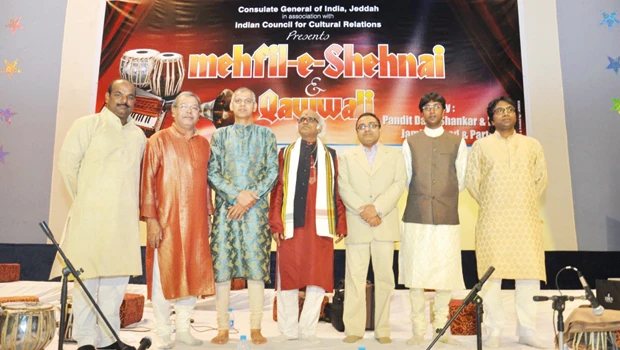
- JEDDAH: Hundreds of qawwali and shehnai aficionados turned up at the International Indian School Jeddah (IISJ) auditorium to enjoy an evening with Jamil Ahmad and his group and Pandit Daya Shankar and his group for two different musical fares.
The musical evening was organized by the Consulate General of India in association with the Indian Council for Cultural Relations (ICCR) as part of festivities to mark the 63rd Republic Day of the country on Friday night.
The huge IISJ hall was filled to capacity with Indians turning up to mark their country’s Republic Day. The twin fare afforded much opportunity for the music lovers to express their appreciation with claps and ovations to the beats of popular numbers.
Every year, the consulate organizes programs to mark the national day. But this year it organized a series of shows in an elaborate manner and all of them got rapturous applause from Indian nationals, foreign diplomats and Saudi officials.
The choice of the classical genre in the twin musical presentations acclaimed the richness and diversity of the nation’s arts and culture. That both the themes come from the northern part of India was incidental.
Shehnai, tube-like instrument gradually broadens toward the lower end, is a wind instrument common in north India, while the qawwali repertoire are mostly in Urdu and Punjabi, languages that are predominantly spoken in the north.
After an early transportation to musical heights by the intrinsic rendition of the shehnai by and Pandit Daya Shankar and his group, the energetic and rousing performance by Jamil Ahmad and his group of qawwals enthralled music lovers in the city.
Acclaimed for his rhythms, beat and melody and enriched by lyrical poetry, Jamil Ahmad brought the house down with his fiery energy on stage. His execution of all time hit "Jab ayee milan ki raat; saiyan ne isa pakda haat ke kangan toot gayee," followed by "O naina lage" and "aap ko chandni me naha ker; and one of the most popular "miane khat likh ker unko bulaya aur qasid ye paigham laya, unke pairoon mein mehndi lagi hai; aane jane ke qabil nahin hain," electrified the crowd.
The function, which lasted until the wee hours of the morning, gave evidence to the fact that 'qawwali' is still a favorite genre of music for many people, including some younger people in the audience. Requests were sent and the artistes obliged them aptly.
Informing that "qawwali" incorporated all genres of music from folk to classical and semi-classical, Ahmad was of the opinion that though some people had tried to add a modern touch to qawwali, it was the original genus, which remained constant and popular. And through his impeccable performance he proved this point.
Ahmad also introduced his disciple Sannawar Ali Khan, a percussionist par excellence. Khan performed on three-tabla and a dholak and successfully established a chord with the audience with his instrumental fusion. Besides Sannawar Khan, Mohammed Usman, Kallan Khan Minai, Mohammed Zaheb, Mohammed Rafi, Shahrukh and Moin accompanied Jamil Ahmad.
Earlier, the evening started with performances by ‘shehnai’ maestro Pandit Daya Shankar, who after having captivated audiences in Europe, Asia and the US with his mellifluous tunes, fascinated Jeddah music connoisseurs here with a virtuoso performance.
Consul General Faiz Ahmad Kidwai and Consul Commercial and Culture Shakeel Ahmad thanked the artistes and gave them gifts to mark the occasion.
The maestro, who hails from a lineage of musicians who have performed shehnai for over 450 years, presented three classical items representing the Banaras (now Varanasi) style of the wind instrument. His variations in dhuns and his explanations of the tune through his vocal skills gave the audience a rare chance to see the tune and vocal being interspersed beautifully. Accompanying him were Ashwani Shankar on shehnai, Pandit Anu Ghose on tabla, Anand Shankar on tabla and dukkar, and Yogesh Kumar Shankar on sur shehnai.
The musical show at IISJ Jeddah followed a reception and a similar shehnai and qawwali show hosted by the consul general, for diplomats, Saudi officials and a select gathering at Hotel Sheraton on Thursday.