- TEHRAN: Iranian lawmakers on Sunday delayed taking action on a proposed bill to immediately cut oil exports to Europe in retaliation for an EU oil embargo, the Parliament’s energy commission said.
“No bill has been designed nor has it come to the Parliament,” commission spokesman Emad Hosseini told Mehr news agency. He said he hoped negotiations on preparing the bill would be finalized before Friday.
Lawmakers had initially been expected to enter the bill into Parliament on Sunday, after calling for it to be drafted under “double emergency” procedures.
The proposed text aims to immediately halt oil exports to Europe in a bid to destabilize the fragile economies of several EU states.
It was called in retaliation for an EU embargo on Iranian oil announced January 16 but whose implementation was meant to be phased in over the next five months to give struggling EU economies, such as Greece and Spain, time to find alternative oil suppliers.
But Hosseini said there was no bill yet, just “an idea by lawmakers” that still had to be studied by the energy commission before one could be drafted.
Iranian officials and lawmakers have expressed anger at the EU ban, which is designed to pressure Tehran to halt its nuclear activities. Western countries allege Iran is seeking a nuclear weapon, despite Tehran’s denials.
Iran is the second-biggest producer in OPEC. It pumps some 3.5 million barrels a day, and exports 2.5 million of them.
Around 20 percent of the exports go to EU countries. Most of the rest goes to Asia, principally China, India, Japan and South Korea.
Ahmad Qalebani, the head of the National Iranian Oil Company (NIOC), was quoted by ISNA news agency as saying Iran was ready to stop its exports to Europe at a moment’s notice, and that clients elsewhere in the world were willing to buy the oil. Meanwhile, UN nuclear inspectors began a critical mission to Iran on Sunday to probe allegations of a secret atomic weapons program.
The findings from the three-day visit could greatly influence the direction and urgency of US-led efforts to rein in Iran's ability to enrich uranium — which Washington and allies fear could eventually produce weapons-grade material. Iran has declined to abandon its enrichment labs, but claims it only seeks to fuel reactors for energy and medical research.
The International Atomic Energy Agency (IAEA) team is likely to visit an underground enrichment site near the city of Qom, 130 km south of Tehran, which is carved into a mountain as protection from possible airstrikes.
Earlier this month, Iran said it had begun enrichment work at the site, which is far smaller than the country's main uranium labs but is reported to have more advanced equipment.
The UN nuclear agency delegation includes two senior weapons experts — Jacques Baute of France and Neville Whiting of South Africa — suggesting that Iran may be prepared to address some issues related ato the allegations that it seeks nuclear warheads.
In unusually blunt comments ahead of his arrival, the IAEA's Deputy Director General Herman Nackaerts — who is in charge of the agency's Iran file — said he wants Tehran to "engage us on all concerns."
Iran has refused to discuss the alleged weapons experiments for three years, saying they are based on "fabricated documents" provided by a "few arrogant countries" — a phrase authorities in Iran often use to refer to the United States and its allies.
"So we're looking forward to the start of a dialogue," Nackaerts told reporters at Vienna airport. "A dialogue that is overdue since very long."
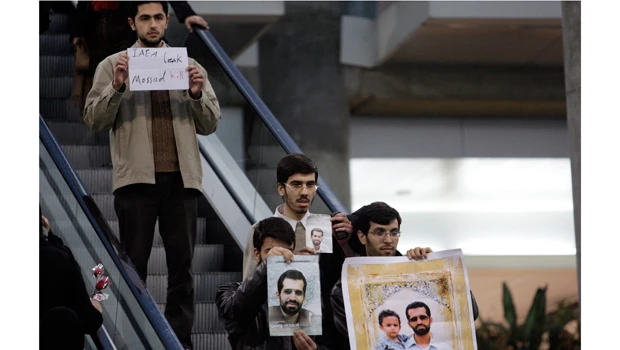
In a sign of the tensions that surround Iran's disputed nuclear program, a dozen Iranian hard-liners carrying photos of slain nuclear expert Mostafa Ahmadi Roshan were waiting at Tehran's Imam Khomeini airport early Sunday.
Iranian state media allege that Roshan, a chemistry expert and director of the Natanz uranium enrichment facility in central Iran, was interviewed by IAEA inspectors before being killed earlier this month in a targeted bomb attack that Iran claims is part of an Israeli-led covert campaign of sabotage and slayings. Roshan was at least the fourth member of Iran's scientific community to be killed in apparent assassinations.
In Vienna, the IAEA said it does not know Roshan and has never talked to him.
But the IAEA team will be looking for permission to talk to key Iranian scientists suspected of working on a weapons program. They also plan to inspect documents related to nuclear work and secure commitments from Iranian authorities to allow future visits. It's unclear how much assistance Iran will provide, but even a decision to enter a discussion over the allegations would be a major departure from Iran's frequent simple refusal to talk about them.
Iran also has accused the IAEA in the past of security leaks that expose its scientists and their families to the threat of assassination by the US and Israel.