
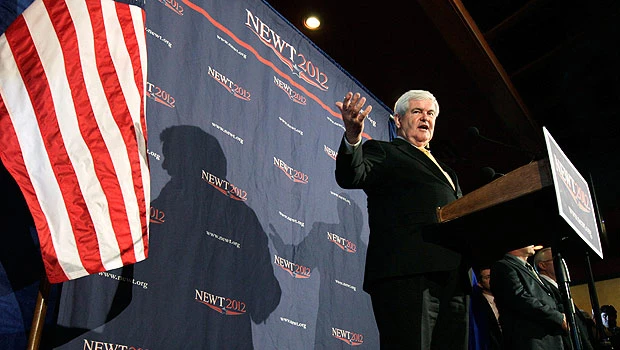
- WASHINGTON: The captivating and chaotic race for the Republican presidential nomination has moved to the American heartland and far West, with Newt Gingrich apparently in line Thursday to win the endorsement of real estate baron and reality television show host Donald Trump.
That news may serve to temporarily diminish attention paid to front-runner Mitt Romney’s remarks a day earlier about poor people. Critics of the ultra-wealthy former venture capitalist say the statement shows he is out of touch with the lives of average Americans.
After a resounding victory over Gingrich in the Florida primary election Tuesday, Romney said the path ahead “is looking very good” as he moved to Minnesota and Nevada for campaign stops. He appeared to be setting his sights on President Barack Obama rather than battling Republican rivals.
But the glow from Romney’s critical win in Florida was quickly dimmed when he said in a CNN interview Wednesday: “I’m not concerned about the very poor. We have a safety net there. If it needs repair, I’ll fix it. I’m not concerned about the very rich. They’re doing just fine. I’m concerned about the very heart of America, the 90-95 percent of Americans who are struggling.”
Politicians in both parties pounced on the remarks as yet another sign that Romney’s huge fortune, estimated to be as much as $250 million, has made him insensitive to the lives of ordinary Americans who are struggling financially in the slow recovery from the Great Recession. Government statistics show that increasing numbers of US families are falling into poverty as the very rich gain an ever-larger share of total US income.
Trump, meanwhile, was set to announce his support of Gingrich on Thursday in Las Vegas, where Gingrich is campaigning in advance of Nevada’s Republican caucuses on Saturday.
Trump’s backing would bring the former House speaker a blitz of media attention heading into the contest and, perhaps, diminish attention to Gingrich’s Florida defeat.
Trump announced Wednesday that he was to make news in the presidential race but did not say what it was. Asked about the possible endorsement Wednesday, Gingrich said he had “no idea what the Donald is going to do.”
“He is always interesting,” Gingrich said of Trump. “And I don’t know of anybody who does a better job of getting attention by announcing that he will presently announce something.”
Trump had flirted with the idea of jumping in the presidential race as a third-party candidate but ultimately decided not to.
Gingrich sought Trump’s endorsement at a meeting in December and agreed to appear in a Republican debate Trump was to host in Iowa. But other candidates, including front-runner Mitt Romney, turned down the invitation, forcing Trump to cancel.
Gingrich became the nominal front-runner in the Republican contest after he won the South Carolina primary last month, drawing on the support of the party’s deeply conservative base, which largely distrusts Romney for his stance on some social issues. South Carolina is one of the most conservative US states, and the primary there was the first test of how the candidates would fare with southern voters.
But Gingrich was quickly brushed aside in Florida where Romney and a political group supporting him unleashed a crushing wave of negative advertising that attacked Gingrich’s character, political history and stability.
Romney has formidable advantages in fundraising and organization. His campaign raised $24 million in the final months of 2011, dwarfing his competitors and leaving him with $20 million to fight a primary battle that’s increasingly spread across many states on the way to the Republican National Convention in August.
What’s more, the nomination fight so far has been defined by debates — typically a strong point for Gingrich — but he faces a three-week stretch without one. The candidates will next debate in Arizona on Feb. 22.
In addition to caucuses in Nevada on Saturday, voters in the far northeastern but lightly populated state of Maine also gather in caucus meetings to select their favorite candidate. Minnesota and Colorado hold contests on Tuesday. Michigan and Arizona hold primaries on Feb. 28.
Romney, a Mormon, won Nevada’s caucuses in 2008, and a substantial Mormon population there could propel him to victory. Still, the libertarian Texas Rep. Ron Paul has been organizing in the state for months and could pose a strong challenge. Romney’s campaign is working to paint the nomination fight as a four-candidate contest, with Paul and the conservative former Pennsylvania Sen. Rick Santorum still in the mix.