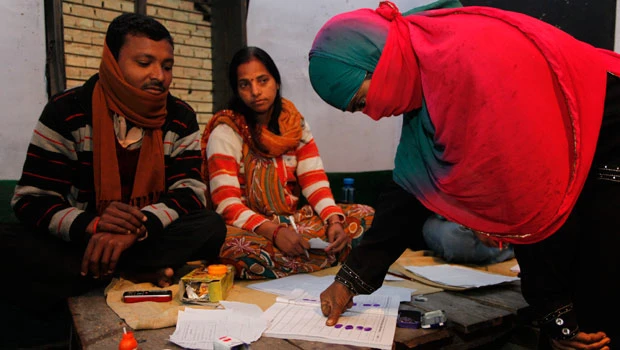
- LUCKNOW: Residents in India's largest state began voting Wednesday in a monthlong local election with repercussions for the whole nation.
- The overall turnout was 62 percent, considerably higher than the 2007 first round tally of 46.7 percent.
A large re-election victory for Mayawati, the chief minister, could project her regional, caste-based party onto the national stage. She was facing off against the Samajwadi Party, which she ousted from power five years ago.
A strong third-place showing for India's ruling Congress Party could make it a kingmaker in Uttar Pradesh and help it gain a new partner to stabilize its fragile national coalition.
"The Congress could shed rebellious partners and could join hands with new political players," said Nominta Kumar, a political analyst at the Giri Institute of Development Studies.
Rahul Gandhi, who is touted as Congress' next prime ministerial candidate, has campaigned across the state for months hoping to prevent a poor showing that could leave the national government crippled for the last two years of its term.
More than debates over corruption and development, identity politics dominated the election campaign in the impoverished state, with Mayawati's low-caste Bahujan Samaj Party facing off against the middle-caste Samajwadi Party.
The state of Uttar Pradesh is so large, with 200 million people, that voting is spread over seven phases and will last until March 3. Results will be declared March 6. "This is a lengthy and complicated process to provide a level playing ground to all the political parties," Chief Electoral Officer Umesh Sinha said.
More than 900 video camera and 1,800 digital cameras will be used to monitor the polls and provide live Webcasts, he said. More than 18 million government employees and 380,000 paramilitary soldiers were supervising the poll.
The crucial Uttar Pradesh elections kicked off on Wednesday with the first of seven phases seeing millions of voters exercising their franchise on a day that had started off cold and damp but warmed up later.
At close of day 5 p.m., officials said an estimated 62 percent of the 17 million had voted in 55 of 403 assembly constituencies in the sprawling state, also India's most populous.
Election day dawned cold and damp with many voters preferring to stay indoors. But voting picked up pace as the sun shone and the temperature rose.
By afternoon, long queues were seen outside polling booths in constituencies in the state’s eastern part. As the day drew to a close, more and more people came out of their homes.
Rain played spoilsport during the first phase of Uttar Pradesh Assembly elections 13.38 percent of the electorate exercising their franchise.
With the weather improving as the day progressed, polling gradually picked up.
“In the first four hours, 13.38 percent polling was registered in 55 assembly seats spread over 10 districts,” Sinha said.
Amid complaints of EVM malfunctioning, 13 percent polling was recorded in Bahraich district.
Sitapur, where people boycotted polling in Gularia village in Misrikh assembly seat to protest lack of development, registered 16 percent polling in the first two hours.
There was slight improvement in Faizabad where 14 percent electorates exercised their franchise till 11 a.m. as compared to 3.5 percent in the first two hours.
Gonda district recorded the highest turnout of 20 percent polling till 11 a.m. The lowest poll percentage of 8 per cent was recorded in Basti district, while Siddharth Nagar district recorded 11 percent.